
How to Multiply Disciples and Churches
Multiplication is not a strategy you run. It is a life you hand off, the way Jesus did, until generations of disciples and churches appear.
Multiplication is not a strategy. It is the result of reproducing the life and ministry patterns of Jesus in others until they naturally reproduce those same patterns in someone else. This is the foundation under everything else on this site: sharing the gospel, making disciples, training them, starting simple churches, and raising up leaders all flow out of one thing. Jesus is our model, and generations are the goal. Here is how it actually happens, and why most disciple-making never gets there.
Almost everyone who wants to multiply disciples starts by looking for the right strategy: the program, the curriculum, the event, the system that will finally make it happen. That is the wrong place to look. After years of watching ordinary Christians actually do this, I am convinced of one thing above all.
Multiplication is not a strategy you run. It is a life you hand off, the way Jesus did, until generations of disciples and churches appear.
That is the whole article in one sentence. Multiplication is the result of reproducing the life and ministry patterns of Jesus in another person, until those patterns become so natural to them that they reproduce them in someone else. Everything else on this site, sharing the gospel, making disciples, training them, starting simple churches, and raising up leaders, is just the outworking of this one thing.
Jesus is our model, and generations are the goal
The biggest key to multiplying disciples and churches is almost embarrassingly simple. Jesus is our model, and generations are the goal.
But before the how, it is worth asking why we aim at multiplication at all. The answer is not efficiency. It is God himself. From the very first page of the Bible, God is a God of multiplication.
Genesis 1:28God blessed them and said to them, “Be fruitful and increase in number; fill the earth and subdue it.”
The first command God ever gave humanity was to be fruitful, multiply, and fill the earth. Multiplication is not a modern ministry trend. It is woven into creation and into the heart of God, and it runs all the way through Scripture, right down to the church in Acts, where “the word of God spread” and “the number of disciples multiplied” (Acts 6:7). So when we long to see disciples and churches multiply, we are not chasing a strategy. We are joining what God has been doing since the beginning.
Notice what that is not. It is not the familiar question, “what would Jesus do?” in a moral, be-a-nice-person sense. The question that changes everything is sharper and more practical: what did Jesus actually do? How did he identify, develop, and send disciples who later reproduced themselves in others? When you read the Gospels with that question, you stop looking for a technique and start seeing a pattern, one you can follow.
And the outcome he was after was never a crowd. It was generations. Paul learned this from Jesus and put it in a single verse.
2 Timothy 2:2And the things you have heard me say in the presence of many witnesses entrust to reliable people who will also be qualified to teach others.
Count the generations in that one sentence: Paul, to Timothy, to reliable people, to others they will teach. That is four generations named in a single breath. The goal was never that Timothy would be well-taught. It was that Timothy would produce a fourth generation Paul would never meet. Keep that picture in front of you, because it is the difference between adding disciples and multiplying them.
Addition asks how big. Multiplication asks how many generations.
Jesus’ multiplication strategy: be with him, then send them out
If Jesus is the model, then the place to learn is the way he built the Twelve. One verse in Mark holds the entire strategy.
Mark 3:14He appointed twelve … that they might be with him and that he might send them out to preach and to have authority to drive out demons.
Read it slowly, because those two phrases are the backbone of everything: that they might be with him, and that he might send them out. Be with him. Be sent out. Jesus first drew disciples close to spend time with him, and then he pushed them out to practice what they had seen. Then he brought them back, debriefed, corrected, and sent them again. That rhythm ran through his entire ministry, over and over, until the disciples could do with others what he had done with them.
This is the pattern every other part of this site depends on. Withness comes before sentness, and sentness flows out of withness. Jesus did not gather a class and lecture until the disciples were ready. He gathered apprentices and put them to work early, alongside him.
Pour deeply into those who respond
Jesus was with people at many different depths, and he chose where to go deep by watching their response. He taught the crowds, sent out the seventy-two, invested in the Twelve, and drew three closer still. He poured the most into the ones who kept responding, the people who followed, obeyed, and came back wanting more. That is still how you find the people to disciple deeply. You do not decide in advance and force it. You watch the response and follow it.
The simplest way to read that response is FAT: faithful, available, and teachable. Faithful with what they have been given, available to be interrupted and make room, and teachable when they are corrected. When you see those three showing up in someone, that is God pointing at a person to pour your life into. Give your deepest time to the responsive few, the way Jesus did, and multiplication follows. Spread yourself equally across everyone who shows mild interest, and it rarely does. This same principle of reading response runs from the four responses to the gospel all the way to identifying and training emerging leaders: you invest according to how people respond.
You cannot reproduce what you do not possess
Here is why “be with him” is not optional, and why no shortcut around it has ever worked. Multiplication happens because of withness. It happens because people spend real time together in ministry, not because information changes hands.
You cannot give away what you do not possess, and you cannot reproduce DNA you do not carry.
This is the quiet reason so much disciple-making stalls. We try to hand people the outcomes of a life we have not actually lived with them. But you cannot text someone a heartbeat. A disciple who has never watched you share the gospel, never sat with you while you opened Scripture with a seeking friend, never seen you pray for a lost neighbor by name, has no living pattern to copy. They have notes. Notes do not reproduce.
So multiplication is not primarily classroom learning, and it is not information transfer. It is life-on-life apprenticeship. It is the reason Jesus lived in front of his disciples for three years instead of handing them a manual. They caught his DNA by being close enough, long enough, to see how he actually lived and then to try it themselves. If you want to multiply, the first question is not “what will I teach?” It is “who am I close enough to that they can catch this from me?”
Immediate obedience, not complete knowledge
One of the most striking things about the way Jesus discipled is what he did not do. He did not wait until his disciples understood everything before he let them minister. He sent them out to preach and heal while they were still confused about who he was. They practiced immediately. They obeyed what they had, before they had it all.
This is the exact opposite of how we usually do it. We tell people to finish the class, complete the training, and reach a level of maturity before they are turned loose. Jesus reversed that order. Obedience came first, and understanding grew out of obeying.
People reproduce before they graduate.
This is why we build disciple-making around obeying what Jesus said rather than accumulating what he said. A new believer reads one command, obeys it this week, tells someone, and comes back having tried, failed, learned, and grown. Then they do it again. That loop, obey now and adjust as you go, is how Jesus formed people, and it is far faster and far deeper than the delay-until-ready approach that keeps most Christians permanently on the bench. If you wait to send people until they know everything, you will wait forever, and you will teach them by your waiting that ministry is for experts. Jesus taught the opposite.
Jesus developed habits, not merely knowledge
Watch closely and you notice that Jesus was not mainly downloading information into his disciples. He was building habits and rhythms into them by living those rhythms with them, again and again, until the patterns were theirs.
Think about what shows up the moment the church is born. When you read Acts 2:36-47, you are not reading about a program someone designed. You are watching the habits Jesus spent three years forming in his disciples spill out into a whole community.
Acts 2:42They devoted themselves to the apostles’ teaching and to fellowship, to the breaking of bread and to prayer.
Those devotions did not appear out of nowhere. They were caught from Jesus. He had practiced them with the Twelve until they became instinct. And this is exactly why the Church Waffle matters, and how to understand it rightly.
The Church Waffle is not an invention. It is an observation.
The twelve practices of the Church Waffle are not a clever ministry framework someone dreamed up and imposed on the Bible. They are a record of the habits and rhythms Jesus established with his disciples, the ones that became visible in Acts 2 when the church began. Broadly, those rhythms fall into five movements that Jesus practiced with his disciples until they could do them with someone else. They are the same five you can see in the four fields of kingdom growth, the four fields plus the leaders raised up at the center:
The rhythms Jesus practiced with his disciples
- Going into lostness. He went to where the lost were and led his disciples out into the harvest, rather than waiting for it to come to them (Luke 19:10).
- Sharing the gospel. He took them with him to reach the lost, and sent them to do it themselves (Luke 10).
- Making disciples. He formed them, and taught them to form others.
- Gathering disciples together. He built them into a spiritual family that ate, prayed, and lived shared life.
- Raising up leaders. He developed the Twelve into people who could lead and reproduce leaders after them, which is its own patient work of identifying and training emerging leaders.
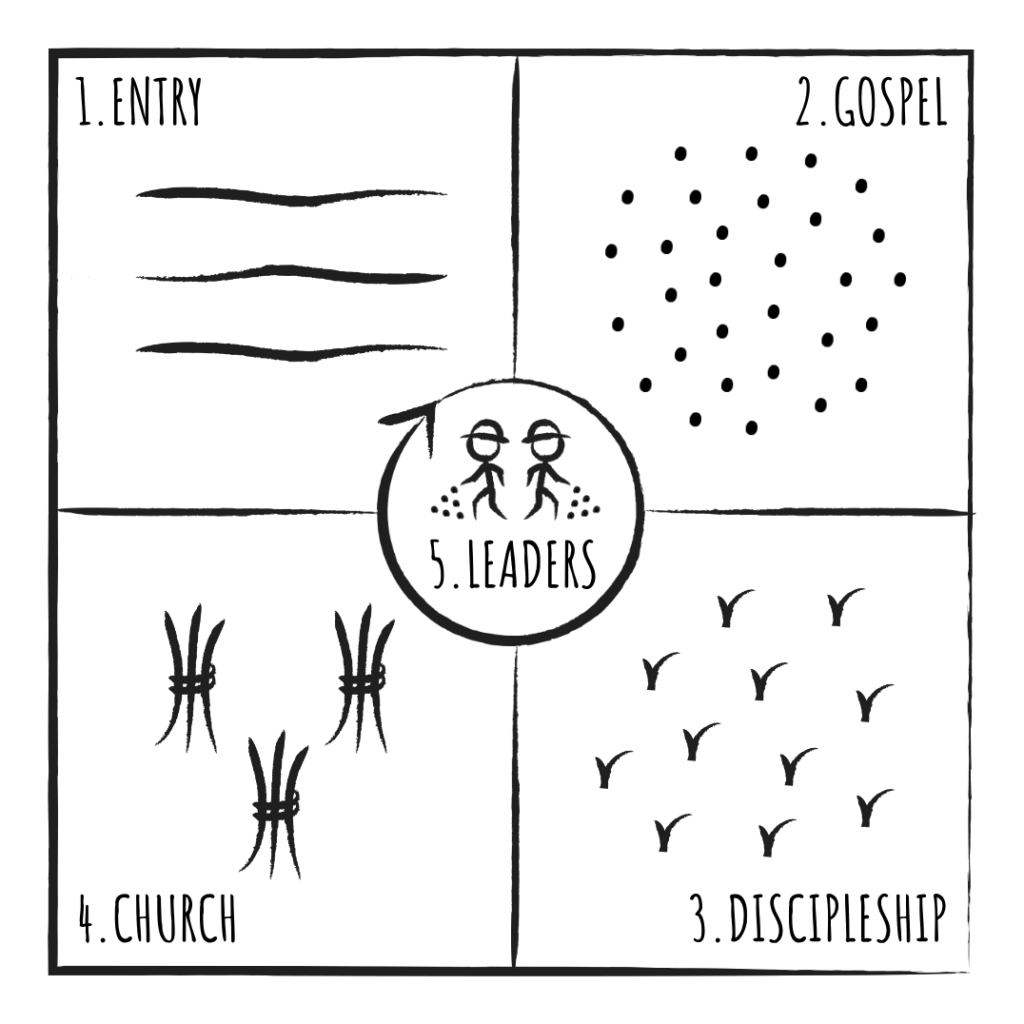
These five are simply the life of Jesus, lived with his disciples until it became reproducible. When we teach the commands of Christ or run a Three Thirds gathering, we are not adding programs. We are practicing the habits of Jesus until they become the habits of the people we disciple.
Multiplication happens through participation: model, assist, watch, leave
If disciples catch habits by doing, then teaching by telling will never be enough. People are formed through participation, not merely instruction. Jesus discipled this way on purpose, and the simplest way to name the pattern is MAWL: model, assist, watch, leave.
MAWL: how Jesus handed off the ministry
Model. Jesus did it while they watched. They saw him preach, heal, and pray before they ever tried.
Assist. He did it with them, letting them take part while he was right there to help.
Watch. He sent them to do it while he stayed close enough to debrief, correct, and encourage.
Leave. He launched them, stepped back, and entrusted the work to them, so that what he started could continue without him in the room.
Every step of MAWL happens in the “with” zone, right up until the last one, and even leaving is only possible because of all the withness that came before it. This is not a leadership technique bolted onto discipleship. It is simply how a life gets handed off. You show someone, you do it together, you watch them try, and then you release them to do it and to hand it off in turn. That final step, leaving well, is harder than it sounds, which is why it is worth learning how to step back without abandoning new leaders. If you have ever taught a child to ride a bike or a coworker to do a job, you already understand MAWL. Jesus did it with the kingdom.

TAKE THE NEXT STEP
You can agree with every word about multiplication and still never carry it, because it is caught in shared life, not learned from an article.
A lab is where you practice the patterns of Jesus with other people, in real ministry, until they become something you can hand to someone else.
Loading the next lab…
The Two-Church Vision
Here is one of our distinctives, and it is the most practical expression of Jesus’ “with” principle we know. We believe every disciple should belong to two churches at once.
The Two-Church Vision
A church where you are being trained. A spiritual family that is discipling you, where you are learning, being corrected, and growing. This is where you are held and formed.
A church you are helping to start. A simple church, out in a pocket of lostness, where you immediately practice what you are learning with people who do not yet know Jesus. This is where you are stretched and where you reproduce.
Think about why this works. Everything above says people are developed while actively practicing ministry, not before it. The Two-Church Vision builds that in. You spend time together with mature believers who are forming you, and you spend time together on mission with people you are reaching. You are always both a learner and a practitioner, at the same time. You are never just sitting in a class waiting to be qualified, and you are never out on your own with no one forming you.
This is withness on both sides. In your training church, someone is doing life and ministry with you. In your mission church, you are doing life and ministry with others, handing off the very DNA you are receiving. It is the “be with him, then be sent out” rhythm of Mark 3, lived every single week.
And it keeps moving. As new disciples in your simple church begin to take ownership and responsibility, and as you see the right DNA reproducing in them, you help them do exactly what was done with them: engage a new pocket of lostness or oikos of their own and begin the whole thing again. One relationship becomes a simple church, which sends out a disciple who starts another. That is how a simple church starts another church, and it is multiplication you can see.
Every disciple needs two churches: one that is training them, and one they are helping to start.
Multiplication always moves toward generations
Keep your eyes on the goal, because it is easy to settle for less. The aim is not a bigger group. It is generations. A first-generation disciple is wonderful. But the question that measures multiplication is whether that disciple has produced a second generation, and whether that second generation has produced a third.
This is the difference between a ministry that adds and a movement that multiplies. It is worth its own honest look in addition vs. multiplication in ministry, and the outcome it aims at is worth understanding in what are generations of churches. It is also the whole point of the power of multiplication and the four fields of kingdom growth. Addition, even fruitful addition, stops with the people you personally reach. Multiplication keeps going into generations you will never meet, exactly like the fourth generation hidden in 2 Timothy 2:2.
So when you disciple someone, disciple them toward a third generation from the start. From the first weeks, ask the question that keeps multiplication alive: who are you going to do this with? Help them start reaching their own people, gathering them, and handing off what they have received. You are not trying to build something big. You are trying to start something that reproduces, and then gets out of the way.
Why most disciple-making never multiplies
If this is so simple, why is it so rare? Because we keep reaching for substitutes that feel like progress but cannot reproduce a life. Multiplication does not come from any of these, no matter how good they are.
Substitutes that never multiply
Acceleration. Trying to go faster does not create generations. Withness takes time, and there is no shortcut through it.
Information transfer. More teaching, better content, and more Bible knowledge do not multiply on their own. You cannot reproduce DNA by describing it.
Bigger events. A larger crowd is addition, not multiplication. Events gather people; they do not hand off a life.
Better curriculum. A stronger program still stops with the people who complete it, and it teaches them that ministry is a course you finish.
Mass training. Training many people at once feels efficient, but competence is caught in shared ministry, not conferred in a session.
None of these is evil, and some are useful in their place. But not one of them can do what only withness does, and when we lean on them as the engine of multiplication, we get exactly what they produce: informed, gathered, well-trained believers who never reproduce. There is one more failure worth naming plainly: we disciple people well and then never help them start a church, so they end up connected to a coach but disconnected from a people. Aim at both disciples and church, or you will multiply neither. For a closer look at where reproduction breaks down at scale, and how to get a stalled work moving again, see why disciple-making movements stall.
Multiplication is spelled s-l-o-w. It is patient, diligent, life-on-life transfer, following the way Jesus modeled.
That is the heartbeat of the whole thing. Multiplication happens through patient, ordinary, relational, reproducible time spent together, doing the ministry of Jesus until the people we are with can do it with someone else. It is slower than a program and faster than you think, because a life, once truly handed off, keeps handing itself off.
What multiplication looks like this week
None of this is theory, and none of it waits for you to feel ready. Multiplication is made of ordinary weeks. Here is what one looks like.
Practice This Week
This week, take one step in each direction of the pattern:
- Be with Jesus. Read a short passage, name one thing to obey, and do it. You cannot give away what you do not possess.
- Take someone with you. Invite one person into something you were already going to do: pray for a lost friend, share a piece of your story, open the Bible with a seeker. Let them watch, or let them try while you help.
- Aim at a generation. Ask the person you are discipling, “Who are you going to do this with?” and help them take one step toward that person.
Then get on the calendar to do it again next week. That repeated rhythm, not a program, is how disciples and churches multiply.
Listen to a conversation on why aiming at only disciples, or only churches, quietly stalls, and how a clear pathway from lost to leader is what actually reaches generations.
Frequently asked questions
What does it mean to multiply disciples and churches?
To multiply disciples and churches means to reproduce the life and ministry patterns of Jesus in another person until they reproduce those same patterns in someone else, and on into further generations. It is different from addition, which stops with the people you personally reach. Multiplication keeps going: a disciple you form helps form another, a simple church you start helps start another, generation after generation, the way Paul described four generations in 2 Timothy 2:2. It is the result of following the model of Jesus, not of running a program.
How did Jesus multiply disciples?
Jesus multiplied disciples by being with them and then sending them out (Mark 3:14). He drew the Twelve close to spend time with him, modeled the ministry in front of them, let them assist, sent them to practice while he stayed close to correct and encourage, and eventually released them to do it without him. He did not wait until they knew everything; he had them obey and practice immediately, then learn from what happened. Over three years he built habits and rhythms into them, the very ones that appear in the church in Acts 2, until they could reproduce his life in others.
What is the Two-Church Vision?
The Two-Church Vision is the conviction that every disciple should belong to two churches at once: a church where they are being trained and formed, and a simple church they are helping to start out in a pocket of lostness, where they immediately practice what they are learning with people who do not yet follow Jesus. It is the most practical expression of Jesus’ “with” principle, because the disciple is always both a learner and a practitioner, being developed while actively doing ministry. As new believers take ownership and reproduce the right DNA, they are helped to engage a new oikos and start the cycle again.
Why doesn’t most disciple-making multiply?
Most disciple-making does not multiply because it leans on substitutes that cannot reproduce a life: acceleration, information transfer, bigger events, better curriculum, and mass training. These can gather, inform, and train people, but they cannot hand off a life, because you cannot reproduce DNA you do not carry, and no one catches a living pattern from a session. Multiplication only comes from patient, life-on-life withness, doing the ministry of Jesus alongside someone until they can do it with another. It also stalls when we disciple people but never help them start a church, so aim at both.
Where to go next
This is the foundation the rest of the site is built on, so start wherever you are on the path. If you are new to it, learn how to make disciples and walk one person through one-on-one discipleship. If you are ready to reach people, begin with sharing the gospel. If disciples are gathering, learn how to start a simple church and what makes a church healthy. And as you are ready to hand it all off, move into training disciples and the power of multiplication. Pick one person and one step this week. That is how it always starts.