
What Makes a Church Healthy?
You cannot organize a church into health. It emerges over time as a family takes ownership of the kingdom. This is how to see it happening.
Church health is not something you organize into existence. You cannot install it with the right programs or manufacture it with enough meetings. It emerges over time, as a church quietly takes ownership of the kingdom for itself. This handy guide is not a checklist of functions to make happen. It is a way to see the fruit as it appears: the signs of a healthy church you can count on your other hand, one through five, drawn from the life of the first church in Acts 2.
When people ask what makes a church healthy, they usually reach for things they can build: better programs, a stronger service, more committed volunteers, the right structure. Set that instinct down. A healthy church is not something you assemble. It is something that grows. If what makes a church a church is the left hand, the simple picture of a church start, then this is the right hand: what a church looks like as it grows up into health. And the first thing to understand about that health is that you cannot make it happen.
Health you cannot manufacture
Church health is not organized into existence. You start simply, and then health emerges over time, as the church itself takes ownership of the kingdom rather than depending on you to run it. This is not a slogan. It is how growth works in God’s economy, and Paul said it plainly about the churches he planted.
1 Corinthians 3:6-7I planted the seed, Apollos watered it, but God has been making it grow. So neither the one who plants nor the one who waters is anything, but only God, who makes things grow.
You plant. You water. But you do not make anything grow, and neither does anyone else. Jesus said the same thing about the kingdom: a farmer scatters seed, sleeps and rises night and day, and the seed sprouts and grows though he does not know how, because all by itself the soil produces grain (Mark 4:26-28). This is why the guide below is not a checklist of functions to install. It is a way to recognize the fruit as it appears, so you can tell the difference between a church you are propping up and a church that is actually coming alive.
That health emerges does not mean you sit back and wait for it. A farmer who does not plant reaps nothing. We get what we aim at, so you aim at both things on purpose: making disciples and gathering them as a church. Health is the fruit that emerges over time from aiming at both, as you disciple the church toward taking ownership of the kingdom. What you cannot do is manufacture that fruit directly, or aim at only one of the two and expect the other to appear on its own.
Five signs of a healthy church
Health leaves marks. As a church matures, certain things start to show up on their own, and you can count them on one hand: one, two, three, four, five. Watch for them the way a gardener watches for fruit, not the way a manager checks a list.
The five signs of a healthy church
1. One Head. The church increasingly answers to Jesus, not to you. He is the head over everything for the church, which is his body (Ephesians 1:22-23). A healthy church is learning to follow its true King directly.
2. Two Authorities. The church leans on the Word of God and the Holy Spirit to guide it (2 Timothy 3:16-17, John 14:26), rather than on a personality or a tradition. Scripture and the Spirit, not you, are increasingly running the room.
3. Three Servants. Servant leaders emerge from within: elders who shepherd (Acts 14:23, Titus 1:5-9), deacons who serve (Acts 6:1-6), and the priesthood of every believer, each one a minister (1 Peter 2:9). Leadership is grown, not imported.
4. Four Marks of Maturity. The church begins to govern, support, reproduce, and correct itself, taking ownership rather than leaning on an outsider. These are worth their own look below.
5. Five Loves. The church expresses the loves of Acts 2: love for God in worship, love for believers in fellowship, love for the lost in ministry, love for the mission in sending, and love for making disciples (Matthew 22:37-39, Acts 2:42-47). Health looks like love, showing up in five directions.
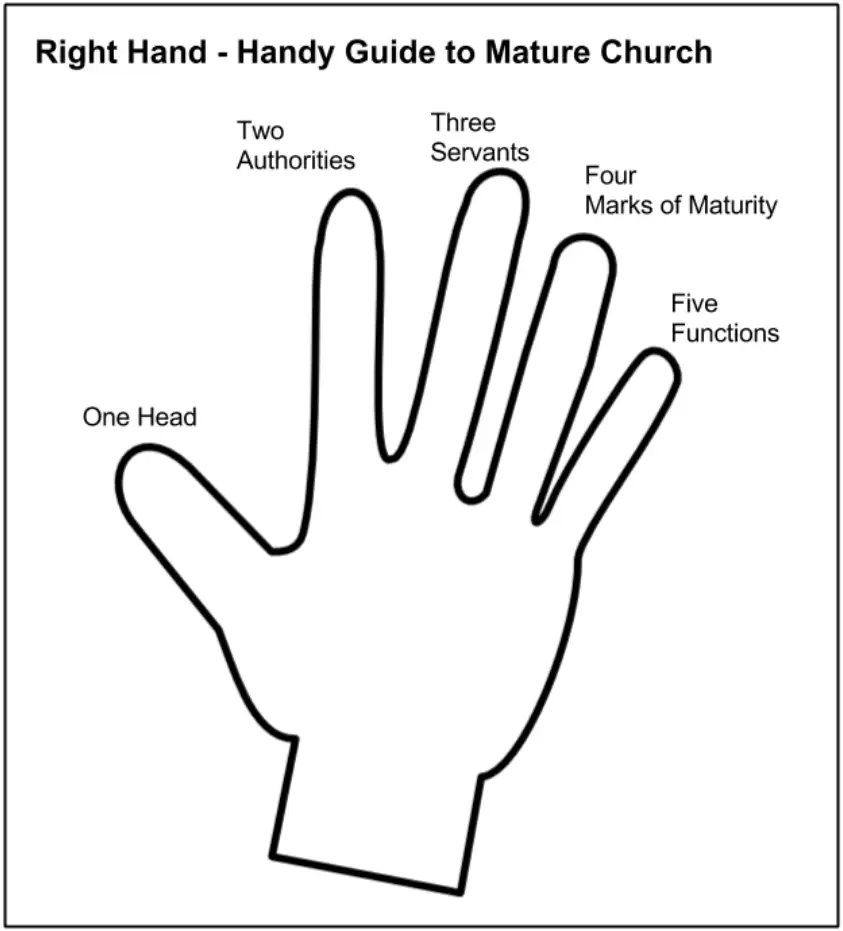
Handy Guide to a Mature Church, with the Scriptures behind each element
Notice these are not tasks you assign. They are fruit you recognize. A church can be young and small and still show early signs of every one, and a church can be large and busy and be missing most of them. Size is not the measure. Emerging ownership is.
The four marks: ownership you can see
The fourth finger is the heart of the whole guide, because it is where you can actually see the kingdom being owned. The four marks of maturity are often called the four selfs, and the simplest way to use them is not as labels but as honest questions.
The four marks of maturity (ask them as questions)
Self-Governing. Who selected the leaders? When a church raises up and recognizes its own leaders rather than having them installed from outside, ownership is emerging (Acts 6:1-7).
Self-Supporting. Who gives? When a church funds its own life and generosity out of its own people, sharing as anyone has need, it is standing on its own (Acts 2:44-45, Philippians 4:14-19).
Self-Reproducing. Who is responsible to reproduce new churches? When the church itself, not just the planter, takes up the work of starting the next one, the fruit is multiplying (1 Thessalonians 1:7-8).
Self-Correcting. Who is making decisions around the Word of God? When a church searches the Scriptures for itself to test what is true and bring its life under Jesus, it no longer needs you to referee (Acts 17:11, 2 Corinthians 10:5).
Read those four questions slowly, because they are diagnostic. If the honest answer to each is still “the outside leader,” the church has not yet taken ownership. As the answers shift to “the church itself,” you are watching health emerge. That shift is the fruit of emerging kingdom ownership, and it is exactly what the right hand of the guide is built to help you see.

TAKE THE NEXT STEP
It is easy to prop a church up with your own effort and mistake your activity for its health, right up until you step back and it stops.
Watching for real, emerging health is something you learn best alongside people who have seen it happen. The CoVo Multipliers community is full of them.
Look for the edge of growth
Because health emerges rather than arrives, do not use this guide as a scorecard to pass or fail a church. Use it to find the edge of growth. Walk the five signs and the four questions, and look for the one place where the next bit of fruit is ready to appear, the next mark of ownership the church is almost ready to take. Then nurture that one edge, and leave the rest to grow in time.
This is the work of the messy middle, the long stretch between a church start on the left hand and a mature, healthy church on the right. A group has become a church (see when a discipleship group becomes a church), but it is not yet standing fully on its own. That in-between is normal, and it is not fixed by pushing harder. It is grown by discipling the church toward ownership and trusting God for the growth.
Galatians 6:9Let us not become weary in doing good, for at the proper season we will reap a harvest if we do not give up.
Practice This Week
Take one church or gathering you are part of and walk the right hand over it. One: is it answering to Jesus, or to a person? Two: is the Word and the Spirit leading, or a tradition? Three: are servant leaders emerging from within? Four: ask the four questions honestly, who selects leaders, who gives, who reproduces, who decides around the Word? Five: which of the five loves are alive? Name the single edge where health is closest to emerging, and take one step to nurture it, not to force it.
Frequently asked questions
What makes a church healthy?
A healthy church is not defined by its size, budget, or programs but by signs of emerging spiritual health you can count on one hand: it answers to Jesus as its one Head, it is led by the Word of God and the Holy Spirit, servant leaders (elders, deacons, and the priesthood of every believer) emerge from within, it grows into the four marks of maturity (self-governing, self-supporting, self-reproducing, self-correcting), and it expresses the five loves of Acts 2 (love for God, believers, the lost, the mission, and making disciples). These are fruit that emerge over time, not functions you organize into place.
What are the four selfs of a mature church?
The four selfs, or four marks of maturity, describe a church that has taken ownership of its own life rather than depending on an outside leader. Self-governing: the church selects and recognizes its own leaders (Acts 6:1-7). Self-supporting: it funds its own life and generosity (Acts 2:44-45). Self-reproducing: it takes responsibility to start new churches (1 Thessalonians 1:7-8). Self-correcting: it searches the Scriptures for itself to test what is true and bring its life under Christ (Acts 17:11). The simplest way to use them is as questions: who selects the leaders, who gives, who reproduces, and who decides around the Word of God?
Can you make a church healthy?
No, not directly. Health emerges; it is not manufactured. You can plant and water, but only God makes things grow (1 Corinthians 3:6-7). What you can do is start simply, disciple the church toward taking ownership of the kingdom, watch honestly for the fruit using the signs and questions above, and nurture the next edge of growth as it appears. Trying to force health by adding programs or effort usually just props a church up on the leader, which is the opposite of the ownership real health requires.
Where to go next
This right hand of the guide only makes sense next to the left: what makes a church a church, the five W’s of a church start. Between the two is the messy middle, which when a discipleship group becomes a church walks through. If you are just beginning, start with how to start a simple church, keep it simple, and trust that health will emerge as the family takes hold of Jesus for itself. And if you are weighing whether to meet in a home or what to call it, remember the container is not what makes a church healthy: house church vs. simple church explains why.