
The Four Fields of Kingdom Growth: Jesus' Pattern for Multiplying Disciples
Entry, Gospel, Discipleship, Church, and Leadership form a simple lens for seeing the whole disciple-making process.
Four Fields of Kingdom Growth is a biblical framework, drawn from Jesus' teaching in Mark 4 and His ministry pattern in the Gospels, for entering new places, sowing the gospel, making disciples, forming churches, and developing leaders who repeat the process.
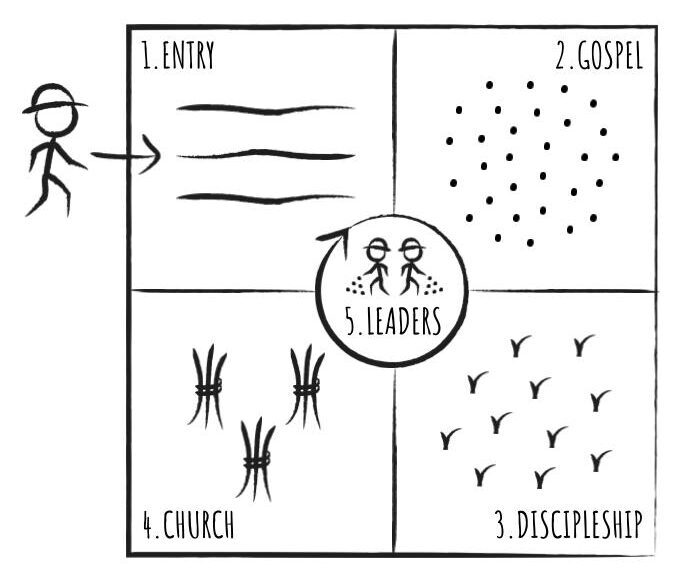
It names four fields of activity, Entry, Gospel, Discipleship, and Church, with Leadership Development at the center sending people back out into new fields. The framework isn’t a system the Bible names outright. It’s a lens practitioners use to recognize a pattern Jesus taught and modeled, so they can ask an honest question: are we participating in the whole process of kingdom growth, or just part of it?
Watch the Four Fields Overview
Watch the complete explanation first, then use the guide below to work through the biblical foundation and each part of the framework.
The Biblical Foundation in Mark 4
Jesus tells a story about a sower who scatters seed. Some falls on a path and birds eat it. Some falls on rocky ground and springs up fast, then withers because it has no root. Some falls among thorns and gets choked out. And some falls on good soil and produces fruit, thirty, sixty, even a hundred times what was sown (Mark 4:1-20).
Same sower. Same seed. Different soils. Different outcomes.
The disciples don’t get it. So they ask Jesus what he means. What he says back is worth sitting with: he asks how they’ll understand any of the parables if they can’t understand this one (Mark 4:13). That’s the only place in the Gospels Jesus says something like this. He’s telling them this parable is a key. Get the principle here, and a lot of the rest of what he teaches about the kingdom will open up.
So what’s the principle? Growth is not uniform, and growth is not guaranteed by the sower’s effort. The sower’s job is to sow. What happens after that depends on the soil, and ultimately on God.
Jesus follows this immediately with a second, shorter parable. A farmer scatters seed, then goes about his life. The seed sprouts and grows, and the farmer doesn’t know how. When the crop is ready, he sends in the sickle for harvest (Mark 4:26-29).
This is the parable Four Fields practitioners, including the South Asia practitioners whose work shaped the Shanks’ manual, have looked to for a pattern. Not because Jesus laid out five numbered steps here. He didn’t. But the shape of the story tracks something practitioners kept seeing in their own work: someone enters a field, sows seed, tends what grows, and eventually gathers a harvest. Out of that harvest, new sowers go out to new fields.
Paul says nearly the same thing to the Corinthians. He planted, Apollos watered, but God made it grow. Neither the planter nor the waterer is anything (1 Corinthians 3:6-9). Keep that guardrail in view through this whole article. Four Fields describes what faithful sowers do. It doesn’t explain how God makes seeds grow. That part stays his.
Four Fields, Five Parts
The name says Four Fields, but the framework actually has five parts. Here they are:
- Entry into new fields
- Gospel sowing
- Discipleship
- Church formation
- Leadership development
Leadership sits in the middle instead of at the end, because it isn’t the last step in a line. It’s the hub that keeps sending people back out to do the first four again, in new places, with new people. A leader who has been discipled and has helped form a church doesn’t retire from the process. They go plant the next field.
These five parts don’t run in strict sequence either. In any given week, a disciple-maker might be entering a new relational space, sharing the gospel with someone else, discipling a handful of responsive people, helping an existing group figure out what it means to function as a church, and walking a developing leader through a next step of responsibility. All five can be happening at once, in different relationships, at different stages.
The manual most associated with this framework, Four Fields of Kingdom Growth: Starting and Releasing Healthy Churches, was compiled and written by Nathan and Kari Shank in 2007 and revised in 2014, drawing on the experience and contributions of a number of South Asia practitioners. The Shanks didn’t invent kingdom growth. Their manual organizes kingdom principles and ministry patterns already found in Scripture into a framework practitioners could use and pass on.
Field One: Enter New Fields
Primary question: Where are people who do not yet know or follow Jesus?
Jesus said plainly that he came to seek and save the lost (Luke 19:10). He didn’t wait for lost people to find their way to him. He went to where they were.
You see this in John 4, where Jesus travels through Samaritan territory, crossing deep religious and ethnic hostility, and ends up in a long conversation with a woman at a well that leads to an entire town hearing about him. You see it in the way he healed the sick and cast out demons as he went, demonstrating the kingdom’s power before he ever finished explaining it in words.
Entry in Jesus’ ministry took a few recognizable shapes. He went into places of lostness directly, demonstrating the kingdom through compassion and power along the way. He also engaged existing religious and community structures, teaching in synagogues where people were already gathered. And he sent his own disciples ahead of him into towns to look for someone who would welcome them and their message (Luke 10:1-12). Practitioners commonly call this a person of peace, shorthand for someone who receives the messenger and what they bring, not a fixed personality type to identify in advance. That kind of welcome often opened the door into an entire household or network of relationships.
For an ordinary disciple, entry isn’t complicated. It usually runs through the people, places, passions, and profession already in your life. Your neighbors. Your gym. Your kid’s school. Your coworkers. The places you already have legitimate reasons to be.
None of that replaces actually saying something about Jesus. Presence and relationship build access and trust, but they aren’t the goal. They’re the on-ramp to the next field.
Start by asking who is already in your life who doesn’t yet know or follow Jesus, and being honest about whether you’re actually engaging them or just standing nearby.
Field Two: Sow the Gospel
Primary question: Who is clearly hearing the good news about Jesus?
Jesus’ own preaching had a clear center. The kingdom of God has come near, so repent and believe the good news (Mark 1:14-15). Paul later summarizes that same good news in a few tightly packed sentences: Christ died for our sins, was buried, and was raised on the third day, all according to Scripture (1 Corinthians 15:1-5).
That’s the gospel. Not a vague call to be a better person or submit to God in general terms. It’s the specific announcement of who Jesus is, what he did in his death and resurrection, and his rightful claim as Lord, along with the call to repent and believe.
The question Jesus was after wasn’t whether someone understood the whole storyline of Scripture before responding to him. It was whether they would submit to him as king. That’s the center of gravity in gospel sharing: helping someone actually encounter the lordship of Jesus and respond to it.
Ordinary disciples generally have two tools available to do this. One is their own story, what Jesus has actually done in their life. The other is the larger story, the gospel itself, God’s plan fulfilled in Christ. Both matter. A personal testimony without the gospel’s content can drift into something less than good news. The gospel’s content without a lived testimony can feel abstract.
This is broad sowing, not narrow targeting. Jesus sowed broadly without assuming beforehand who would respond. That means resisting the urge to turn every person into a project, and it means not pressuring for an immediate decision. Some tools that help structure this kind of conversation, worth exploring further, include a short personal testimony format sometimes called a fifteen-second testimony, the Three Circles gospel presentation, and a set of Seven Stories of Hope drawn from Scripture.
The honest check here isn’t how many conversations you’ve had. It’s whether anyone has actually and clearly heard the gospel from you lately, not just felt your presence around them.
Field Three: Make Disciples
Primary question: Who is learning to hear and obey Jesus?
Jesus called specific people out of the crowds that followed him (Mark 3:13-15). He didn’t disciple everyone the same way. He invited a smaller group to be with him, watch him, and eventually do what they’d watched him do.
His pattern had real substance to it. He taught directly. He explained what parables meant when his disciples didn’t understand. He corrected them when they got things wrong. He modeled ministry in front of them, then gave them chances to practice it themselves, then sent them out to do it without him. Discipleship in Jesus’ hands was not a method of only asking questions and never giving answers. He gave plenty of answers. He also asked questions that made people think, corrected wrong assumptions, and let his disciples fail and learn.
It helps to think of discipleship in two horizons. Short-term discipleship is the work of helping a new believer understand who they are in Christ, what God is like, the basic story of Scripture, and the commands Jesus gave. Long-term discipleship is the ongoing work of helping someone abide in Christ the way a branch abides in a vine (John 15:1-8), reading and obeying Scripture, recognizing the Spirit’s leading, and growing in character. Jesus put it simply about himself: he only did what he saw the Father doing, and said what he heard the Father saying. That’s the destination for a maturing disciple, learning to recognize and obey God’s leading through Scripture and the Holy Spirit without remaining dependent on a trainer for every step. That doesn’t make teachers, church community, or spiritual leadership optional. It means a disciple is growing toward maturity within that community, not stuck permanently at the starting line.
One reproducible rhythm some practitioners use to structure ongoing discipleship meetings is called 3/3rds, a simple pattern of looking back at obedience since the last meeting, looking up at Scripture together, and looking forward to what’s next. It’s a useful tool for one part of discipleship, not the definition of discipleship itself. Four Fields describes the whole disciple-making and church-planting process. 3/3rds is one meeting rhythm that can operate inside that process.
This all connects back to the command Jesus gave before he left: go and make disciples of all nations, baptizing them and teaching them to obey everything he commanded (Matthew 28:18-20). The real test in this field isn’t how many people you’re informing about Jesus. It’s who is actually learning to obey him.
Field Four: Form Healthy, Reproducing Churches
Primary question: Where are new disciples becoming a church together?
This field needs more care than the others, because it’s easy to move too fast here. Jesus gathered a covenant community around himself during his ministry. That group became the foundation for the church, but it wasn’t yet functioning as the church we read about after Pentecost. Acts 2 shows what that looked like once it took shape: believers devoted to the apostles’ teaching, fellowship, and prayer, sharing generously, worshiping together, and growing daily as the Lord added to their number (Acts 2:36-47).
A healthy church, in this framework, isn’t just any group that meets regularly. It’s a body marked by baptized believers, devotion to Scripture, real fellowship, prayer, the Lord’s Supper, generosity, mutual care, gospel witness, obedience to Jesus, recognized leadership, and a posture of sending people out on mission. That’s a fuller picture than a weekly Bible study or an informal gathering of friends who talk about faith. The goal in this field is helping disciples actually become a functioning church under the lordship of Jesus, not simply producing another meeting.
Some practitioners use a simple diagnostic sometimes called the Church Circle to help a group evaluate which of these practices are present and which are missing. It’s useful as a diagnostic. It doesn’t create a church by itself. Only the Spirit forms a church, through people actually living these practices together over time.
So the question worth sitting with here isn’t whether your group meets. It’s whether it’s actually functioning as a church.
Leadership Development at the Center
Primary question: Who is becoming able to reproduce the whole process?
Watch how Jesus worked with the twelve and you can see him modeling ministry in front of them, drawing them into participation, giving them room to practice, correcting them along the way, and gradually handing them more responsibility until he sent them out to do the whole task themselves. Jesus didn’t teach this as a formal four-stage system. MAWL gives us a useful summary of how he developed his disciples through modeling, participation, practice, and release:
- Model: I do, you watch.
- Assist: I do, you help.
- Watch: You do, I help.
- Launch: You do, and you train someone else.
You can see something similar in Acts, as Paul and Barnabas retrace their steps through the churches they’d planted and appoint elders in each one, praying and fasting as they commit these leaders to the Lord (Acts 14:21-23). Leadership in the New Testament isn’t casual. It comes with real character qualifications, and appointing leaders is treated as a serious act, not a fast-tracked convenience.
Leadership in this framework begins through faithful participation and demonstrated character over time, not through a title handed out early. Developing leaders doesn’t mean setting aside the biblical qualifications for elders and other recognized leaders. It means looking for leaders to emerge out of the harvest itself whenever possible, people who were reached, discipled, and formed within the very process they’ll go on to lead. The aim throughout is reproduction, not ongoing dependence on whoever started the work. A leader who has gone through this whole process is now positioned to go back to field one and start again somewhere new. Which raises the practical question: who are you actually developing right now, and what’s the next step of responsibility you could hand them?
How the Five Parts Work Together
Four Fields works best as a diagnostic, a way of examining your own ministry activity, rather than a rigid pipeline you march people through in order. Here’s a simple way to check yourself against all five parts at once:
| Part | Diagnostic question |
|---|---|
| Entry | Who are we intentionally engaging? |
| Gospel | Who is clearly hearing the gospel? |
| Discipleship | Who is obeying Jesus and helping others obey? |
| Church | Where are new disciples becoming a church? |
| Leadership | Who can reproduce the whole process? |
A ministry can become strong in one or two fields while quietly neglecting another. A ministry might gather believers well on Sunday but rarely enter new relational spaces with people who don’t know Jesus. Another might constantly share the gospel with strangers but never sit down with the people who respond to actually disciple them. A group might disciple people faithfully for years without helping them function as a church together. A church might run smoothly except in one place: it never develops and sends new leaders, so everything depends on the people already in charge.
An imbalance is not automatically evidence of unfaithfulness, but it deserves honest examination. Sometimes it reveals a limitation in the current season. Sometimes it exposes an area where comfort, tradition, or fear has displaced obedience.

TAKE THE NEXT STEP
A framework only matters when it changes what you do in the field.
A live lab gives you a place to turn disciple-making ideas into concrete practice alongside other practitioners.
Loading the next lab…
A Lens, Not a Formula
This is the part worth slowing down for, because it’s easy to miss.
Four Fields cannot produce spiritual life. No diagram creates a movement. God alone determines growth and its timing, the same way he did in the parable of the growing seed, where the farmer sows and reaps but has no idea how the seed actually grows in between. The Holy Spirit is the one doing the actual work of regeneration, conviction, and transformation in a person’s life. Scripture judges this framework, not the other way around. If a claim doesn’t hold up against what the Bible actually says, the framework is wrong, not Scripture.
That also means the framework needs adapting to different cultures rather than applied the same way everywhere. And it means faithful ministry can still produce slow, hidden, or genuinely difficult fruit. Applying Four Fields carefully doesn’t guarantee rapid or visible multiplication. Treating it like it does runs counter to the gospel itself, which teaches that Jesus alone, and faith in him alone, is what saves and transforms someone. No method gets credit for that.
What the framework does give you is a lens. A way of noticing what God may already be doing around you, and a way of asking what your next act of obedience actually is. That’s a humbler claim than a formula, and it’s also a more honest one.
How to Start Using Four Fields This Week
You don’t need a training program to begin. Try this simple exercise.
- Draw the Four Fields diagram on a piece of paper, four boxes around a center circle labeled Leadership.
- Write the names of actual people and groups currently connected to each field in your life right now.
- Look at what you’ve written and identify which field is getting the least attention.
- Choose one concrete action you can take in that field this week.
- Tell another practitioner what you’re going to do, and ask them to follow up and ask what happened.
A few examples of what that action might look like: showing up consistently in one relational space you’ve been neglecting. Sharing the gospel clearly with two specific people. Starting to read Scripture together with someone who’s shown interest. Sitting down with a group of disciples and asking together whether they’re actually functioning as a church. Taking one developing leader through a single Model, Assist, Watch, or Launch step they haven’t done yet.
If you want a deeper walkthrough of how to actually train a team using this framework, the implementation guide goes further into that process.
The diagram plus field-by-field worksheets you can take to a team
Listen to a practitioner-to-practitioner conversation on how these same fields, worked patiently in Acts, become a movement rather than a program.
Frequently Asked Questions
Why is it called Four Fields if there are five parts?
The name comes from the four fields of activity: Entry, Gospel, Discipleship, and Church. Leadership Development is the fifth part, but instead of being another field alongside the others, it sits at the center, developing the people who will carry the whole process into new fields.
Is Four Fields explicitly taught in the Bible?
No. The Bible doesn’t name a system called Four Fields. The framework is a practitioner tool built from kingdom principles Jesus taught, especially in the parables of Mark 4, and from patterns visible in his ministry and the early church in Acts. It’s a lens for recognizing those patterns, not a passage of Scripture.
Is Four Fields the same as the 3/3rds process?
No. Four Fields is a framework for understanding the whole disciple-making and church-planting process, from entry through leadership. 3/3rds is a specific reproducible meeting rhythm, looking back, looking up, looking forward, that some practitioners use within the discipleship field. One is the whole picture. The other is one tool that fits inside it.
Is Four Fields only for missionaries and church planters?
No. Any disciple can engage all five parts in ordinary life, through existing relationships, workplaces, and neighborhoods. Missionaries and church planters often use the framework more formally, but the underlying pattern applies to any believer trying to be intentional about making disciples.
Does Four Fields guarantee a disciple-making movement?
No. Faithfulness to this pattern doesn’t guarantee rapid or visible results. God alone gives growth, and growth can be slow, hidden, or difficult even where someone is being genuinely faithful. The framework helps with stewardship. It doesn’t control outcomes.
Where can I read the original Four Fields manual?
Nathan and Kari Shank’s full manual, Four Fields of Kingdom Growth: Starting and Releasing Healthy Churches, is the original and most complete source for this framework.
Conclusion
Set the diagram down for a second and look at what’s underneath it. Jesus calls his followers to enter the harvest, proclaim the gospel, make disciples, gather disciples into churches, and develop leaders who do it all again. Four Fields is just a way of checking whether we’re actually participating in that whole process, or only the parts we find comfortable.
Draw the diagram. Be honest about who’s connected to each field in your life right now. Find the one that’s been neglected. And take one obedient step toward it this week.