
APEST Leadership and the Five Functions of a Multiplying Team
Christ gives apostles, prophets, evangelists, shepherds, and teachers to equip the whole church for maturity and mission.
When a Church Develops Only Two Functions
Most churches are good at two things: teaching and caring. Someone opens the Word faithfully. Someone else remembers your name, checks in when you are sick, and shows up when life falls apart. Neither of these is the problem.
The problem appears when two functions are expected to carry the whole ministry of the body. A church can be well taught, deeply cared for, and still struggle to carry the gospel into new people and places. Pioneering becomes rare. Hard questions about obedience go unasked. Believers remain unsure how to communicate the gospel outside the church.
This is not a call to replace pastors or invent new titles. It is a recognition that Christ gives different kinds of equipping people to his church. Ephesians 4:11-16 names apostles, prophets, evangelists, shepherds, and teachers. Each makes a distinct contribution that the others may not naturally emphasize.
When only shepherding and teaching are developed, the church can become lopsided and struggle to keep moving outward. The answer is not less shepherding or teaching. The answer is those functions working alongside pioneering, prophetic discernment, and evangelistic equipping.
What Does APEST Mean?
APEST stands for Apostle, Prophet, Evangelist, Shepherd, and Teacher. The acronym is modern, but the five terms come from Paul’s letter to the Ephesians.
Ephesians 4:11-16 begins:
“He gave some to be apostles; and some, prophets; and some, evangelists; and some, shepherds and teachers; for the perfecting of the saints…”
The passage continues by explaining why Christ gives these people. They equip the saints for ministry, build up Christ’s body, help it reach unity and maturity, protect it from false teaching, and teach it to speak truth in love. The passage ends with every part contributing to the body’s growth.
Read the sequence carefully. Christ gives people to the church. Those people equip the saints. The saints participate in ministry, and the whole body grows. The emphasis is not a leadership elite doing ministry while everyone else watches.
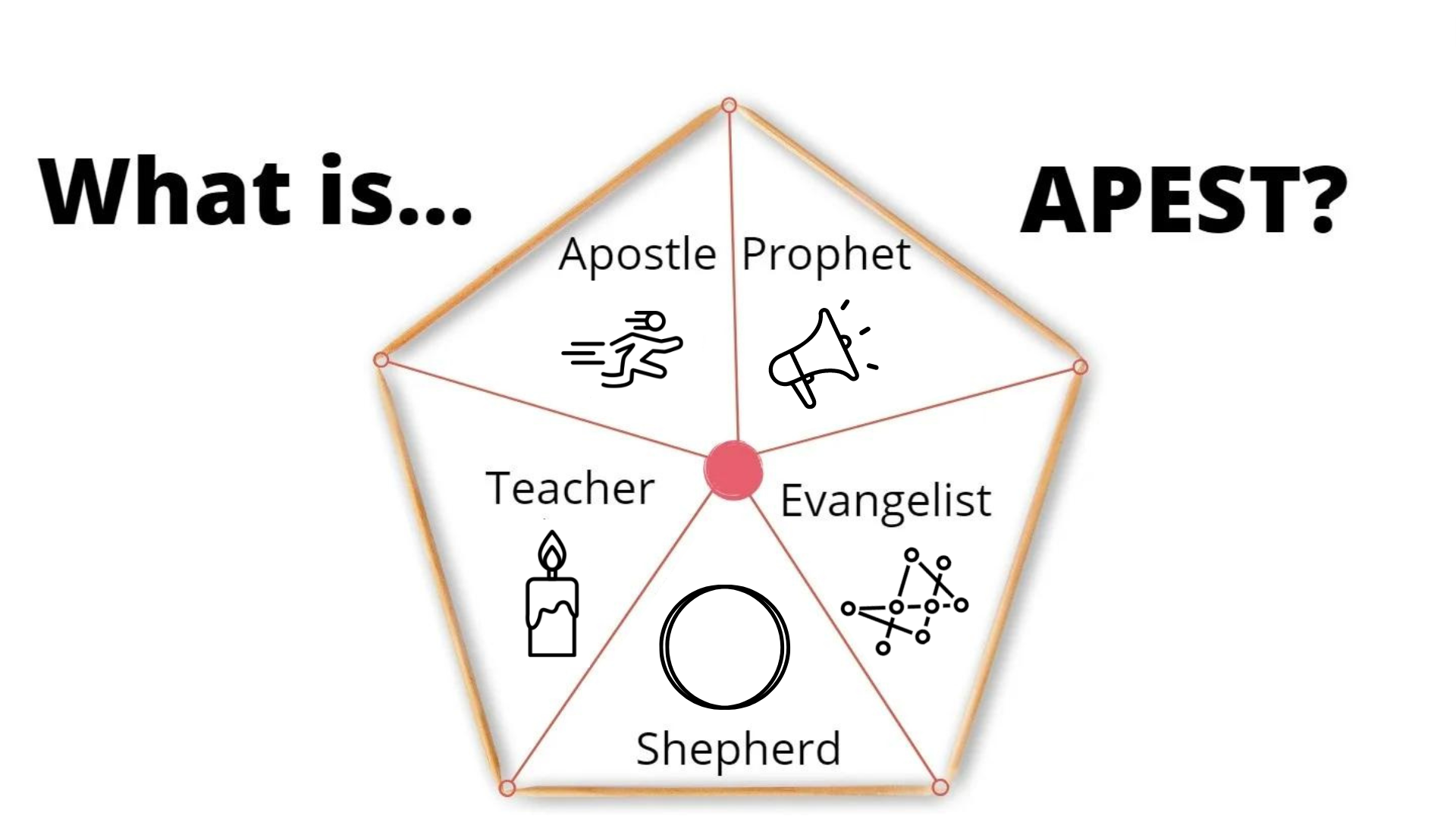
Use the navigation below to jump to a function, or keep reading to see how the biblical passage governs the framework.

The Apostle
- Core contribution: Pioneers gospel work, crosses barriers, and lays foundations.
- Equips others to: Enter new fields, establish reproducible work, and develop local leaders.

The Prophet
- Core contribution: Calls the body to attend to God, discern drift, and obey faithfully.
- Equips others to: Listen, test what they hear, speak truth in love, and respond through obedience.

The Evangelist
- Core contribution: Communicates the good news and keeps people far from God visible to the church.
- Equips others to: Explain the gospel clearly, invite a response, and connect evangelism with discipleship.

The Shepherd
- Core contribution: Nurtures, protects, reconciles, and forms healthy spiritual community.
- Equips others to: Care for one another, address conflict, protect the vulnerable, and remain connected.

The Teacher
- Core contribution: Explains and applies Scripture accurately.
- Equips others to: Understand, obey, study, and pass biblical truth to others.
Is APEST Biblical?
The five descriptions are biblical. The acronym and many contemporary applications built around them are not.
Apostle, prophet, evangelist, shepherd, and teacher come directly from Ephesians 4:11. What is modern is grouping them under one acronym and using that framework to discuss team composition, church planting, leadership development, and personal ministry patterns. Alan Hirsch, Tim Catchim, Neil Cole, Mike Breen, and other contemporary writers did not originate the biblical ministries. They helped churches and mission practitioners recover and apply them.
That recovery can be useful, but some applications go beyond what Ephesians explicitly states. The passage does not present APEST as a personality test. It does not say every Christian can be assigned one permanent type. It describes people Christ gives to equip the saints and build his body.
Christians also disagree about how the passage should be understood. Some see apostles and prophets as foundational offices limited to the first-century church. Others believe apostolic and prophetic functions continue without carrying the authority of the Twelve or adding to Scripture. Christians also debate whether these should be called offices, gifts, callings, functions, or gifted people, and whether “shepherds and teachers” describes two closely connected groups or one pastor-teacher expression.
This article does not attempt to settle every debate. It uses APEST as a functional framework for recognizing how different people equip the church for maturity and mission. The functions should be recognized through character, fruit, repeated behavior, the ability to equip others, and confirmation from the believing community. Titles should never outrun those realities.
The word function is deliberate. Ephesians says Christ gives people to his church. It does not command every congregation to install five formal offices or provide an organizational chart. Describing five equipping functions allows us to take the passage seriously without pretending every interpretive question has been settled.
It also keeps us from locking people into one category. Paul functioned apostolically, but he also taught, evangelized, shepherded, and spoke prophetically. Peter provides clear examples of evangelistic function, but that does not make evangelism his only contribution. Every believer participates in the church’s ministry, and many believers will demonstrate recurring strength in one or more of these functions. The framework is most useful when it helps the body recognize contribution and least useful when it becomes a fixed identity system.
The Purpose of APEST: Equipping the Saints
Performing a ministry function is not the same as equipping other believers to participate in it.
An apostolic person may start new work. A mature one equips others to enter new fields and establish work that will outlast their involvement. A prophetic person may discern where a church has drifted. A mature one equips others to listen, test, and obey. An evangelistic person may communicate the gospel well. A mature one equips ordinary disciples to do the same. A shepherding person may care for people personally. A mature one equips the body to care, reconcile, and protect. A teaching person may explain Scripture clearly. A mature one equips disciples to study, obey, and teach it themselves.
Neil Cole makes this point in Primal Fire. He writes, “It is only when all these gifts are released to function naturally in the body and they mature to the point of equipping others” (introduction, p. xxii). Cole’s sentence continues by connecting this shared maturity to the church reflecting Jesus. His concern is not filling five positions. It is the fullness of Christ becoming visible through a body in which the gifts work together and equip others.
The test is not only, “What can this person do?” It is also, “What are other believers learning to do because this person equipped them?”
Maturity is not measured only by personal effectiveness. It is also measured by reproduction. A mature function strengthens the saints rather than making its strongest practitioner indispensable.
APOSTLE
The Function of the Apostle
What the apostolic function contributes
The Greek word apostolos refers to one who is sent or commissioned. In the New Testament, the word does not carry the same weight in every context. The Twelve had a unique, unrepeatable role as chosen witnesses of Jesus. Paul received a unique commission and exercised foundational authority. No contemporary leader possesses the foundational authority of the Twelve or Paul, and Christians should be cautious about claiming the title “Apostle.”
The New Testament also uses apostolic language more broadly. Acts 14:14 calls Barnabas an apostle alongside Paul. That broader usage helps us recognize an apostolic function without confusing contemporary pioneers with the foundational apostles. You can explore that distinction further in what the word apostle means across the New Testament.
Apostolic function pioneers gospel work, crosses geographic and cultural barriers, lays foundations, establishes new communities, and develops leaders who can carry the work forward. It is not merely entrepreneurship, innovation, restlessness, or organizational vision. The defining issue is being sent for gospel advance and establishing work that strengthens Christ’s church.
A mature apostolic person is courageous, collaborative, adaptable, and willing to suffer. They guard the gospel foundation of new work, develop reproducible patterns, and release responsibility rather than gathering everything around themselves.
A New Testament example
Paul gives a clear example of apostolic function in Romans 15:18-20. He sought to preach where Christ was not known rather than build on another person’s foundation. His goal was not novelty for its own sake. He entered new fields, proclaimed Christ, established communities, and developed leaders who could continue the work.
Immature or distorted expression
Immature apostolic function becomes restless, isolated, or obsessed with visible results. It may treat people as projects, overvalue innovation, distrust care and structure, or abandon work before it is established. Personal ambition can be confused with being sent. Starting receives more attention than stewarding the fruit.
When apostolic function dominates
A team dominated by apostolic function may expand without building sufficient stability, unity, or depth. Growth can become fragmented, and slower people may be neglected in the rush toward the next field.
What apostles need from the other functions
Apostolic people need prophets for direction and correction, evangelists for clear gospel communication, shepherds for care and lasting community, and teachers for biblical depth and faithful transfer. Pioneering work becomes durable when the other functions strengthen what has been started.
Apostolic function in movements
In disciple-making movements, apostolic function often helps a team enter a new field, confront barriers, and establish foundations simple enough for local believers to reproduce. It develops local leaders instead of making an outside worker permanently necessary. Movement trainer Curtis Sergeant notes that biblical apostolic ministry tends to lift others up and avoid dependency, in contrast to modern uses of the title that emphasize prominence.
A pioneer who never releases responsibility may build dependency instead of laying a foundation. Mature apostolic ministry leaves behind local people who can obey Jesus, develop others, and carry the gospel farther.
PROPHET
The Function of the Prophet
What the prophetic function contributes
Prophetic function helps the church attend to God rather than drift into autopilot. It calls the body back to faithfulness, notices contradictions between confession and practice, and speaks truth that leads toward repentance and obedience. It is not limited to predicting the future.
This function needs clear safeguards. Contemporary prophetic ministry does not add to Scripture and does not carry Scripture’s authority. First Corinthians 14:29 tells the community to weigh prophetic speech. First Thessalonians 5:20-21 tells believers not to despise prophecy, but to test everything and hold on to what is good. “God told me” cannot be used to avoid testing, Scripture, or accountability.
Mature prophetic function is humble, courageous, patient, accountable, and submitted to Scripture. It speaks truth in love and seeks restoration rather than superiority. It is also willing to act on what has been discerned.
A New Testament example
Agabus gives a clear example in Acts 11:27-30. He warned of an approaching famine, and the disciples responded by sending relief to believers in Judea. The prophetic contribution did not end with information. It helped move the body toward faithful action.
Immature or distorted expression
Immature prophetic function becomes harsh, proud, impractical, or constantly critical. Personal preferences may be treated as revelation. The person may resist being tested, speak without love, or enjoy exposing problems more than helping people respond faithfully.
When prophetic function dominates
A team dominated by prophetic function may spend considerable time listening, discerning, and correcting while struggling to coordinate action. Insight becomes detached from practical obedience and movement.
What prophets need from the other functions
Prophetic people need apostles to turn discernment into action, evangelists to communicate truth clearly to outsiders, shepherds to join correction with care, and teachers to ground insights in Scripture and make them understandable and transferable.
Prophetic function in movements
Sergeant observes that apostolic and prophetic people often need each other and irritate each other when new work begins. Apostolic people tend to favor action, while prophetic people tend to favor listening. Action without listening can become self-directed. Listening without action can become passive. Held together, the functions help a team hear and obey.
In a movement, prophetic function keeps methods from quietly replacing dependence on God. It exposes shortcuts that appear productive but compromise obedience, calls teams back when results matter more than faithfulness, and helps the work remain spiritually responsive rather than mechanically efficient.
EVANGELIST
The Function of the Evangelist
What the evangelistic function contributes
Evangelistic function communicates the good news of Jesus clearly and moves naturally toward people who have not heard it. It helps believers see lost people rather than only church activity, communicates in language outsiders understand, and calls for a response.
Its equipping contribution is essential. A mature evangelistic person does not protect evangelism as a personal specialty. They help ordinary disciples communicate the gospel faithfully in their own relationships and communities. They connect gospel proclamation with repentance, baptism, discipleship, and belonging to the body.
Evangelistic people also help the church hear its own language through an outsider’s ears. They notice when Christians are using unexplained terms, answering questions nobody is asking, or making the gospel harder to understand than it needs to be. Clarity does not mean reducing the message. It means communicating the whole good news of Jesus in language a real person can follow.
Mature evangelistic function is compassionate, courageous, clear, patient, and centered on Jesus. It cares about disciples rather than merely decisions and remains connected to follow-up and community.
A New Testament example
Philip provides a clear example in Acts 8. He proclaimed Christ in Samaria and then explained the gospel to the Ethiopian official from the passage the man was reading. Peter in Acts 2 and Acts 10 also demonstrates evangelistic function, though Peter’s ministry cannot be reduced to one category.
Immature or distorted expression
Immature evangelistic function becomes manipulative, exaggerates results, or minimizes the cost of following Jesus to gain a faster response. It can treat conversion as the finish line, neglect follow-up, chase crowds, and grow frustrated with people who respond slowly.
When evangelistic function dominates
A team dominated by evangelistic function may see many gospel responses without durable discipleship or lasting churches. New believers can be left without the community and biblical foundation needed to grow.
What evangelists need from the other functions
Evangelistic people need apostles for foundations and new-field strategy, prophets for discernment and integrity, shepherds to gather and care for new believers, and teachers to root disciples in Scripture and obedience.
Evangelistic function in movements
In disciple-making movements, evangelistic function helps gospel sharing become normal, reproducible, and widespread rather than dependent on a specialist. Multiplication does not come from one gifted evangelist working harder. It grows as believers are equipped to communicate the gospel faithfully and help those who respond take their next steps in following Jesus.
Evangelistic energy alone is not enough. Gospel sharing must lead toward discipleship, baptism, community, obedience, and believers learning to make other disciples.
SHEPHERD
The Function of the Shepherd
What the shepherding function contributes
Shepherding function provides care, protection, belonging, reconciliation, and patient guidance. It helps people remain connected to Jesus and to one another. It is one of the primary ways a collection of believers becomes a spiritual family.
A mature shepherd is present and patient. They protect without controlling, address sin rather than avoiding every difficult conversation, and help people grow instead of making them dependent. Mature shepherds also equip the body to care for one another rather than becoming the sole caregiver.
Shepherding is not opposed to mission. Its contribution ensures that people reached through mission become part of a community where they are known, protected, corrected, and loved.
This function also equips believers to carry responsibility for one another. Instead of routing every need to one pastor, shepherding people help the body learn to notice absence, pursue reconciliation, bear burdens, protect vulnerable people, and restore those who have wandered. The mature result is not one heroic caregiver. It is a community that has learned to practice the care of Jesus together.
A New Testament example
Barnabas demonstrates shepherding function through encouragement, advocacy, and relational investment. He vouched for Paul when believers in Jerusalem were afraid of him (Acts 9:26-27), strengthened the church in Antioch, and insisted on taking John Mark when Paul refused (Acts 15:36-39).
Immature or distorted expression
Immature shepherding avoids hard conversations, protects comfort, resists needed change, or creates dependence. It can confuse unity with the absence of disagreement, prioritize insiders while neglecting outsiders, and take responsibility for care the whole body should learn to carry.
When shepherding function dominates
A team dominated by shepherding may develop strong internal care with little outward mission. Protecting present relationships can become more important than welcoming new people, sending workers, or making needed changes.
What shepherds need from the other functions
Shepherding people need apostles to keep the community moving outward, prophets to address drift and compromise, evangelists to keep people far from God visible, and teachers to ground care in biblical truth.
Shepherding function in movements
Rapid multiplication can become shallow, fragmented, or relationally unsafe without shepherding. New believers need to become a spiritual family, not simply a growing number in a report. Shepherding function helps new churches practice care, reconciliation, protection, and mutual responsibility.
Healthy shepherding does not close the circle. It forms the kind of secure community that can release people into mission without losing relational health.
TEACHER
The Function of the Teacher
What the teaching function contributes
Teaching function explains Scripture accurately and connects truth with obedience. It helps disciples understand what they believe and why, guards the church from false teaching, and makes truth clear enough to pass on to others.
A mature teacher is biblically grounded, clear, humble, patient, and open to correction. They care about what learners obey, not merely what they know. Their teaching produces disciples who can study Scripture and help others understand it instead of remaining permanently dependent on the teacher.
Ephesians 4 connects maturity with stability against false teaching. Teachers contribute to that stability by helping believers read Scripture in context, recognize distortion, and connect individual passages to the larger story of God. They do more than transfer correct information. They show disciples how to handle the Word faithfully when the teacher is not in the room.
Teaching and multiplication are not enemies. The question is whether biblical depth becomes transferable wisdom or an educational bottleneck.
A New Testament example
Priscilla and Aquila demonstrate teaching function in Acts 18:24-28. They took Apollos aside and explained the way of God more accurately. Their example joins biblical accuracy with humility, relational correction, and reproduction.
Immature or distorted expression
Immature teaching accumulates knowledge without obedience. It can become proud, perform for admiration, make simple truth unnecessarily complicated, treat disagreement as ignorance, or create dependent learners who cannot study and teach Scripture themselves.
When teaching function dominates
A team dominated by teaching may produce knowledge without corresponding obedience or multiplication. Discussion and theory can displace mission, practice, and engagement with people who do not yet know Jesus.
What teachers need from the other functions
Teaching people need apostles to connect truth with pioneering mission, prophets to keep learning responsive to God, evangelists to communicate truth accessibly and engage new believers, and shepherds to understand learners and teach within healthy relationships.
Teaching function in movements
Movements need biblical depth without creating a bottleneck around one trained teacher. Teaching function helps truth remain accurate while also making it simple enough to understand, obey, and pass on. It equips disciples to open Scripture, discover what it says, apply it, and help someone else do the same.
Without teaching, multiplication can spread confusion. Without reproduction, teaching can become a classroom that never releases its students.
In a discovery-oriented group, this may look less like delivering every answer and more like teaching people to observe the text carefully, name what it reveals about God, identify a concrete act of obedience, and pass what they learn to someone else. The teacher still guards accuracy, but does so in a way that strengthens learners rather than replacing their responsibility.
What Happens When One Function Dominates?
Every function is good. The problem begins when one operates in isolation from the other four.
| Dominant function without the others | Likely result |
|---|---|
| Apostle | Expansion without stability |
| Prophet | Discernment and correction without coordinated action |
| Evangelist | Gospel responses without lasting discipleship |
| Shepherd | Strong care with little outward movement |
| Teacher | Knowledge without obedience or multiplication |
These are cautions, not mechanical predictions. The problem is not that a function is strong. The problem is isolation. Each strength can produce a corresponding weakness when it refuses correction and contribution from the others.
Alan Hirsch and Tim Catchim describe shepherding and teaching as stabilizing, integrative functions. Apostolic, prophetic, and evangelistic ministries bring more generative and adaptive contributions. Their concern is not that churches should value shepherds and teachers less. It is that stability becomes stagnation when separated from mission, correction, and gospel movement.
As they write in The Exiling of the APEs, “We need to re-embrace and re-integrate the ministries of the apostle, prophet, and the evangelist with those of the shepherd and teacher” (p. 1).
APEST is not a hierarchy of personal value. The word “first” in 1 Corinthians 12:28 does not establish that apostles possess greater personal worth. It may indicate order or functional priority, but it should not be used to place apostles above the rest of Christ’s body. Different seasons may require different functions to take initiative.
The answer to an overextended shepherd is not less shepherding. It is shepherding joined to pioneering, discernment, gospel proclamation, and biblical teaching.
Mature leaders welcome people who notice what they miss.

TAKE THE NEXT STEP
A church that develops only shepherding and teaching will struggle to move outward and multiply.
Recognizing a function on paper is not enough. APEST becomes visible through practice, community, and equipping others. Connect with disciple-making practitioners who are working through these challenges together.
How APEST Functions Together in Disciple-Making Movements
The five functions overlap, but seeing their contributions together can help a team diagnose repeated weaknesses.
- Apostolic function helps teams enter new fields and lay reproducible foundations.
- Prophetic function keeps the work responsive to God, Scripture, correction, and obedience.
- Evangelistic function equips disciples to carry the gospel into their relationships and communities.
- Shepherding function gathers believers into healthy, accountable spiritual families.
- Teaching function roots disciples in Scripture and helps truth reproduce accurately.
This is not always a chronological sequence, and it does not require five separate specialists in every local church. One person may demonstrate several functions. No one should operate without accountability. Movements are works of the Holy Spirit, not the mechanical result of assembling five personality types. APEST does not replace prayer, abiding in Christ, character, obedience, or dependence on God.
Curtis Sergeant’s Equipping Disciples for Ministry as Kingdom Priests provides one of the clearest applications of APEST to movements. He writes, “The Lord intends his Church to equip every disciple to listen to God and do what He says” (printed p. 39).
In Sergeant’s model, apostolic and prophetic functions are especially important when new work begins because they help establish its direction and foundational patterns. As communities become established, shepherding and teaching normally become more prominent, while prophetic and evangelistic equipping remain important throughout. This is Sergeant’s movement observation, not a rigid sequence every Christian must derive from Ephesians 4.
Sergeant also argues that every small church does not need five identifiable specialists. The functions may be supplied across a city or regional network of churches. People can serve across congregations, equip others, and strengthen a contribution that is weak or absent locally.
Imagine a team entering a new neighborhood. Apostolic contribution helps it identify barriers, establish a simple foundation, and develop local leaders. Prophetic contribution keeps the team listening, testing its assumptions, and obeying what God reveals. Evangelistic contribution equips believers to communicate the gospel in the relationships already present. Shepherding contribution helps responding people become a spiritual family. Teaching contribution roots that family in Scripture and helps truth pass accurately from one disciple to the next. These contributions may overlap or appear in a different order, but the team is stronger because none is expected to carry the work alone.
Consider a team that enters the harvest consistently and generates many gospel conversations but struggles to gather responding people into durable churches. More evangelistic activity may not be the missing ingredient. The team may need stronger shepherding to form spiritual family, teaching that new disciples can obey and pass on, and apostolic clarity about the foundation being established.
The immature patterns and interdependence details in this article draw in part from Sergeant’s observations. Their value is diagnostic. APEST helps teams notice what is missing and invite the needed contribution closer.
How to Recognize APEST Functions Without Labeling People
Function is recognized through fruit over time, not simply through a self-selected label.
Ask:
- Where does this person consistently bear fruit?
- What do they naturally notice that others overlook?
- What do other believers begin doing because this person equipped them?
- Does the believing community recognize this contribution?
- Is the function joined to Christlike character?
- Has it remained faithful over time?
- Can the person receive correction from people with different functions?
- Does their ministry strengthen the whole body?
- Do they release others or make themselves indispensable?
- Is the claimed gifting visible in practice?
Self-awareness is useful, and an assessment may begin a worthwhile conversation. Even Alan Hirsch’s official APEST assessment describes ministry more carefully than a personality label: “Ministry vocation is a mixture of personal identity, God’s calling, the Spirit’s gifting, and community discernment.”
The assessment measures a person’s current ministry motivation and expression. Its 360-degree version compares self-perception with how other people experience the person’s ministry. A test cannot confer calling, authority, maturity, or credibility. Those become recognizable through character, fruit, community confirmation, and faithfulness over time.
Context matters too. The same person may pioneer in one setting, shepherd in another, and teach when a particular need arises. The goal is not to find the label that explains everything about a person. It is to notice the grace Christ is expressing through them and ask whether that contribution equips and strengthens the rest of the body.
Look at patterns of service before choosing terminology.
A Practical APEST Team Exercise
This exercise works best with an actual team:
- List the people actively contributing to your team or church.
- Write down demonstrated functions, not preferred labels.
- Note which functions are strong, weak, or absent.
- Identify problems that may be connected to those absences.
- Decide whether to develop someone internally or invite another person closer.
- Choose one real ministry challenge that requires several functions to work together.
That challenge might be entering a new neighborhood, helping new believers become a church, addressing repeated conflict, increasing gospel sharing, correcting doctrinal confusion, or developing local leaders.
Finish the exercise with one action, an owner, and a date. Then review what happened. Did several functions actually contribute, or did the team default to the same one or two people again? The exercise becomes useful when it changes how the team works, not when it merely produces an interesting set of labels.
Do not ask only, “Which letter am I?” Ask, “What does this body need in order to become mature and faithful to its mission?”
Conclusion: No Titles Required
APEST is not about collecting titles. It is a way of recognizing the different people Christ gives his church and the distinct contributions they make as they equip the saints.
Every function needs the others. Churches need shepherds who care and teachers who ground people in truth. They also need people who pioneer new work, call the body back to faithfulness, and equip believers to carry the gospel outward.
The goal is not a perfectly balanced leadership chart. It is a functioning body that obeys Jesus, cares for its own, and carries the gospel into new people and places, with every part contributing.
Look at the people God has already placed around you, recognize the grace he has given them, and help each one equip the whole body for the work Jesus has given you.
Sources and Further Reading
- Ephesians 4:11-16; Romans 15:18-20; Acts 8; Acts 9:26-27; Acts 11:27-30; Acts 14:14; Acts 15:36-39; Acts 18:24-28; 1 Corinthians 4:8-13; 1 Corinthians 12:28; 1 Corinthians 14:29; 1 Thessalonians 5:20-21
- Neil Cole, Primal Fire: Reigniting the Church with the Five Gifts of Jesus (Tyndale Momentum, 2014)
- Alan Hirsch and Tim Catchim, The Permanent Revolution: Apostolic Imagination and Practice for the 21st Century Church (Jossey-Bass, 2012)
- Curtis Sergeant, “Equipping Disciples for Ministry as Kingdom Priests,” Mission Frontiers, July/August 2023, pp. 39-44
- Alan Hirsch, APEST Vocational Assessment, The Forgotten Ways / 5Q Central
- Steven Chang, “What Is the Apostolic and Why Is It Important?,” The Missions Leaders Blog, 2025