How to Get Started in Four Fields Training
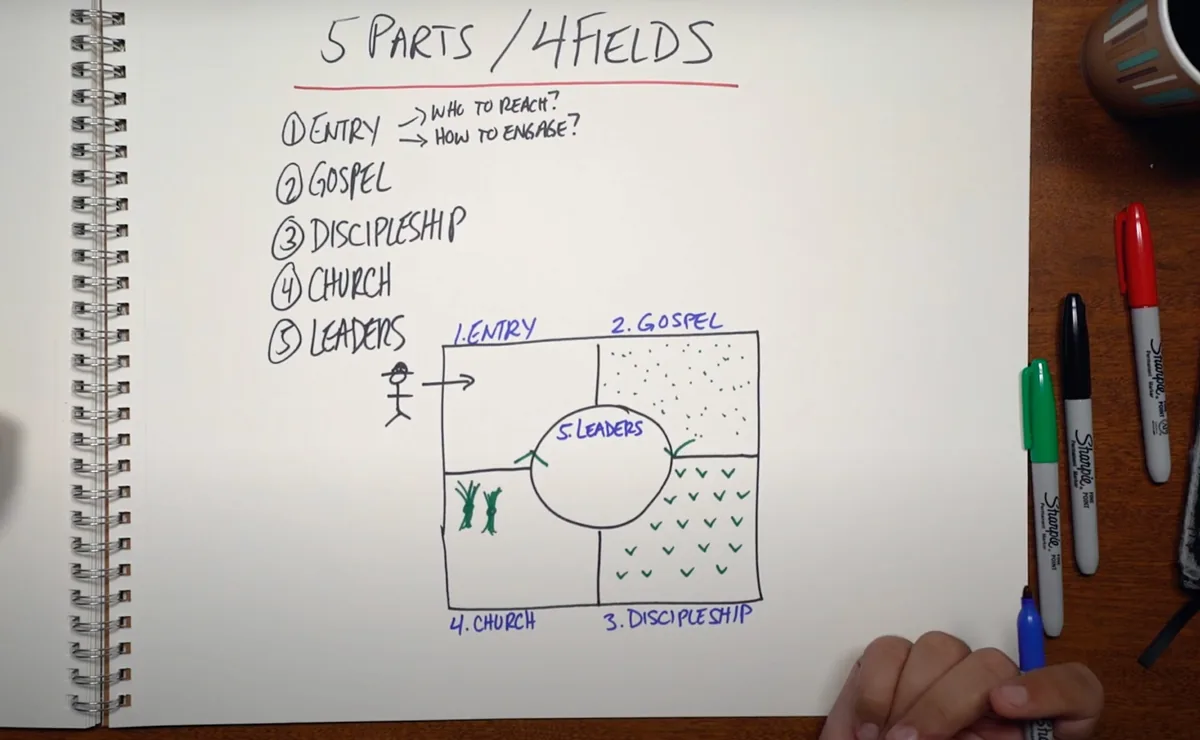
Multiplying disciples is the core task Jesus gave His disciples in the Great Commission. However, it can be challenging to know where to start or how to make an impact. Four Fields Training is a comprehensive approach that has revolutionized ministry work.
This guide will provide an in-depth understanding of 4 Fields discipleship using the Four Fields Training, including the history, training structure, benefits, and implementation.
Frequently Asked Questions
What is Four Fields Training?
Four Fields is a discovery-based discipleship framework that maps Jesus’ process in Mark’s Gospel: Entry (finding receptive people), Gospel (broad sowing), Discipleship (developing obedience), and Church (gathering for multiplication). It develops disciple-makers who reproduce through their natural relationships (oikos).
How long does it take?
Initial training takes 2-3 days to grasp the framework. Real mastery develops over 2-3 years through coached practice in actual ministry—learning by doing, not just knowing. You master it like riding a bike, not passing a test.
Do I need special credentials?
No. You need faithful availability and willingness to engage lost people in their spaces. The Gerasene demoniac had zero training—just a testimony and access to ten cities through his existing networks.
What’s the difference between training and implementation?
Training gives you the map. Implementation is the journey. Most people get trained but never start. You need a coach to help you actually walk the path, process failures, and develop reproducers.
What if I fail?
You will. Jesus’ disciples did repeatedly. Failure becomes your teacher when you reflect on experience with a coach. The question isn’t if you’ll fail but whether you’ll learn and persist.
Introduction to Four Fields / Five Parts Training
Jesus didn’t build an institution through programs and professionals. He launched a movement through ordinary people who learned kingdom patterns by doing kingdom work.
Four Fields captures Jesus’ reproducible process Jesus models in His earthly ministry. It’s not a curriculum to teach but a pattern to live. The framework reveals how Jesus systematically moved from Entry (calling disciples at their nets) through Gospel sowing (broad proclamation), Discipleship (intensive development), to Church formation (gathered community) and Leadership multiplication (sending the Twelve).
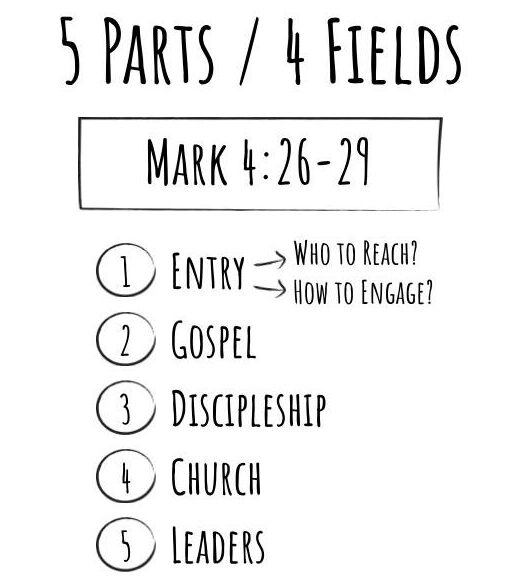
Jesus reveals this process He has been modeling to His disciples in Mark 4 when He says:
26 “The kingdom of God is like this,” he said. “A man scatters seed on the ground. 27 He sleeps and rises night and day; the seed sprouts and grows, although he doesn’t know how. 28 The soil produces a crop by itself—first the blade, then the head, and then the full grain on the head. 29 As soon as the crop is ready, he sends for the sickle, because the harvest has come.”
Mark 4:26-29
The genius is its simplicity. As in the ministry of Jesus, a new believer can grasp the process in hours and begin passing it on within weeks. That’s why movements multiply through Four Fields while complex systems stall at the founder.
The last part in leadership development recognizes that you’re not just making disciples—you’re developing reproducers who make disciples who make disciples. Leadership isn’t a later stage. It’s woven into every field from day one as you watch for the faithful, available, teachable, and reproducing (FATR).
The process is circular, not linear. You don’t complete one field and move to the next. You’re simultaneously entering new spaces, sowing gospel seed, developing disciples, gathering communities, and raising leaders. Each field informs and strengthens the others.
Four Fields Diagram
The following diagram was created to communicate some important principles about the Four Fields Process:
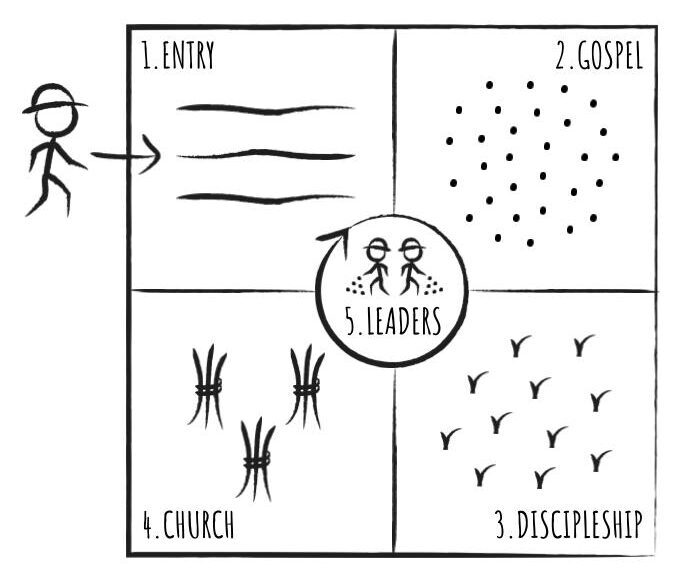
Notice the arrow on the circle in the middle indicating a holistic cycle. Each part of the strategy is interconnected, and it is essential to understand the significance of each step.
The approach is designed to create a self-replicating process that can continue to grow, even after the initial ministry work is completed.
Understanding the 4 Fields Discipleship Process
Field One: Entry (eg. Mark 1:16-20, 2:13-17)
Jesus went to where lost people were. He didn’t wait for them to come to religious spaces. He entered their workplaces (fishing boats, tax booths), their social networks (Levi’s feast), their everyday contexts.
You’re looking for people of peace—those who welcome you, receive your message, and open their networks. These become bridges into entire communities. One transformed person with access to their oikos is worth a thousand religious contacts who know no lost people.
The Practice: Identify a specific place where lost people naturally gather. Go there regularly. Build genuine relationships. Watch for those who demonstrate receptivity. When you find them, enter their world—their home, their social circles, their existing relationships.
The Trap: Extracting people from their networks into your religious space. The moment you pull them out of their oikos and into your church building, you’ve killed their multiplication potential. They become consumers, not reproducers.
Field Two: Gospel (eg. Mark 1:14-15, 38-39)
Jesus scattered seed broadly through proclamation, then looked for responsive soil. He didn’t try to convince the hard-hearted. He moved on quickly, seeking those ready to respond.
The gospel spreads fastest through existing trust relationships. Stories, not sermons. Conversations, not presentations. Celebration, not condemnation. You create spaces where lost people encounter Jesus in culturally appropriate ways—often in homes, over meals, through testimony.
The Practice: Share your story and God’s story simply. Use the 3/3rds process (thanks/accountability, worship, story discussion, practice, goals). Let the responsive invite their friends and family. Watch who brings others—that’s your person of peace. Focus there.
The Trap: Trying to reach everyone instead of finding the responsive few. Jesus left crowds to invest in those ready to reproduce. Broad sowing isn’t about universal conversion—it’s about discovering good soil.
Field Three: Discipleship (eg. Mark 3:13-14, 4:10-20)
Jesus developed disciples through discovery, not lectures. “Come and see.” “What do you think?” He let them wrestle with truth themselves through questions and real-world application.
Discovery-based learning creates ownership. When people find truth in Scripture themselves, guided by good questions, they remember it. They can teach it to others. They develop the skill of learning from God’s Word, not dependency on you to explain it.
The Practice: Use discovery Bible studies with the 3/3rds rhythm. Ask questions, don’t give answers. Let the group discover what the passage means and how to obey it. Focus on obedience, not just information. Every session should end with “I will…” commitments that get reported on next time.
The Trap: Teaching instead of facilitating. Complexity instead of simplicity. Knowledge without obedience. If people can’t immediately reproduce what you’re doing with their friends, it’s too complicated.
Field Four: Church (Mark 3:31-35, 6:7-13)
Jesus formed communities around obedience to God’s will, not around programs or buildings. “Whoever does God’s will is my brother and sister and mother.” These gatherings existed to multiply, not just maintain.
Church isn’t a building or event. It’s a gathered community practicing the functions Paul describes in 1 Corinthians: teaching, worship, fellowship, Lord’s Supper, giving, prayer. When believers gather with multiplication DNA from the start, reproduction happens naturally.
The Practice: Gather simple churches in homes or workplaces using reproducible patterns—worship, Word, works, witness. Keep it simple enough that a new believer could start one in weeks, not years. Celebrate when churches multiply. That’s health, not loss.
The Trap: Creating dependency on you, special venues, or professional skills. If it requires a seminary degree, a building, or a sound system to function, it won’t multiply past you. Simple is reproducible. Complex dies with the founder.
Field Five: Leadership (Mark 6:7-13, 30-31)
Jesus identified leaders from the frontlines—people actually doing the work, not those volunteering for positions. He looked for FATR: Faithful in small things, Available for investment, Teachable to correction, and Reproducing with others.
Leadership development happens through the MAWL cycle: Model (I do, you watch), Assist (I do, you help), Watch (You do, I help), Leave (You do, someone else watches). You move people through this cycle in 2-3 years, not 2-3 decades.
The Practice: Watch who actually obeys. Who shares their faith? Who starts groups? Who brings others to training? Invest extra time in those people. Coach them through each field until they can coach others. Release them when they’re 70% ready, not when they’re perfect.
The Trap: Appointing leaders based on potential or position rather than proven faithfulness. Holding onto leaders too long because you need them. A leader you don’t release to multiply is a bottleneck, not an asset.
The History and Impact of Four Fields / Five Parts Training
The framework emerged in the 1990’s into the early 2000’s as practitioners began to pray and fast and rediscover the process of Jesus in the Word.
Missionary catalysts worked with indigenous leaders to model and train the reproducible patterns they were using. They weren’t inventing something new. They were making explicit what Jesus modeled in the Gospels and Paul implemented in Acts.
The breakthrough wasn’t the diagram. It was the shift from extraction-based ministry (pulling people into our programs) to engagement-based multiplication (entering their spaces and developing reproducers). From professional clergy doing ministry to every-believer activation. From complex systems that require experts to simple patterns that reproduce naturally.
The Impact:
- Movements reaching unreached people groups with zero previous Christian presence
- Churches planting churches to 4th, 5th, even 10th generations within years
- Ordinary believers—farmers, shopkeepers, day laborers—becoming movement catalysts
- Saturation of entire regions through natural network multiplication
The key wasn’t discovering a better method. It was recovering Jesus’ original method—the one we’d complicated and professionalized beyond recognition.
In restricted access nations, where traditional church planting is impossible, Four Fields enabled explosive growth. House churches multiplied because the pattern was simple, reproducible, and didn’t require buildings, salaries, or seminary training.
In Western contexts, where church attendance is declining, Four Fields offers a pathway back to organic multiplication through relationships rather than depending on attractional events.
The framework now guides movements on six continents, translated into dozens of languages, adapted to countless cultures—all because it captures something universal: Jesus’ reproducible process for making disciple-makers.
The Four Fields Training Curriculum
Discovery-Based Learning
Participants don’t receive lectures. They examine biblical texts directly—often Luke and Acts—finding patterns themselves before any teaching. The trainer facilitates with questions, not downloads.
Why this works: What you discover, you own. What you’re told, you forget. Discovery creates the capacity to teach others because you learned how to find truth yourself, not just hear someone else’s conclusions.
The Training Flow:
- Read Mark 1:9-39 and Luke 8-11 together, looking for patterns
- Identify the Four Fields in Jesus’ ministry
- Diagram the process visually
- Discuss implications for your context
- Plan concrete first steps
Practical Application
Training isn’t theoretical preparation. You leave with an action plan for your actual context:
- Specific place you’ll enter this week (not “somewhere eventually”)
- Named individuals you’ll engage as potential persons of peace
- Mapped oikos networks showing existing relationships you can leverage
- Discovery groups you’ll start within 30 days
- First leaders you’ll begin developing
The training session is the starting line, not the destination. Most training fails because people learn concepts but never implement. Four Fields training ends with implementation plans you execute immediately.
Reproducibility Filter
Every tool, every exercise passes through one question: Can someone with no formal training reproduce this easily?
If it requires you to explain it, it won’t multiply. If they can turn around and do it with their people tomorrow, it will.
This ruthless simplicity filter is why Four Fields multiplies while most discipleship curricula stall. Complexity is the enemy of reproduction.
Examples of reproducible tools:
- 3/3rds process (any believer can facilitate)
- Discovery questions (printed on a card)
- Four Fields diagram (drawn on napkins)
- MAWL coaching cycle (easy to remember and apply)
- Generational vision (mapping your spiritual family tree)
Non-reproducible approaches:
- Complex theology requiring seminary education
- Curriculum depending on professional teaching skills
- Processes requiring special venues or equipment
- Methods demanding significant time most people don’t have
The Training Environment
Effective Four Fields training happens in simple spaces, not conference centers. Living rooms, not lecture halls. Around tables, not in rows. This models the reproducibility—if training requires expensive venues, you’re already creating dependency.
Training groups stay small (12-20) so everyone participates actively. Large audiences create passivity. Small groups demand engagement.
The NoPlaceLeft Vision
Paul wrote from Rome: “There is no more place for me to work in these regions” (Romans 15:23). Not because everyone believed, but because self-sustaining, multiplying movements existed in every strategic location that could reach their own regions without him.
That’s the vision. Not extracting individuals into our churches but catalyzing indigenous movements that multiply naturally through local leaders reaching their cultural contexts.
NoPlaceLeft means:
- Every people group has access to the gospel through movements in their language, culture, and context
- Every region has multiplying churches that plant churches to multiple generations
- Every neighborhood has believers actively making disciples in their natural relationships
- Every oikos network gets saturated with gospel presence
NoPlaceLeft is measured by:
- Generational depth (4th generation churches, not just first)
- Geographic spread (movement covering regions, not isolated churches)
- Indigenous ownership (local leaders multiplying without outside dependency)
- Sustainable reproduction (movements that sustain themselves after catalysts leave)
This vision reframes success. You don’t measure by:
- How many people attend your church
- How impressive your facilities are
- How large your budget grows
- How many staff you employ
You measure by:
- How many generations of churches emerge
- How many regions get saturated with multiplying disciples
- How many local leaders can reproduce the full process
- Whether movements sustain after you leave
Paul could leave regions because multiplication DNA was embedded. The movement belonged to local leaders who could reproduce it naturally. That’s the goal.
Benefits of Four Fields of Kingdom Growth Training
Rapid Multiplication Through Simplicity
When patterns are simple enough to reproduce, they do. You see movements, not just church growth. Fourth-generation churches emerge within years, not decades.
Traditional church planting aims for one church every few years. Four Fields movements see churches planting churches monthly. The difference? Reproducibility. A pattern anyone can pass on multiplies exponentially. A complex system requiring experts grows linearly at best.
Indigenous Ownership From Day One
Local leaders own the work from the start because it’s simple enough for them to lead immediately. You’re not creating dependency on outside workers, foreign funding, or professional clergy.
The movement belongs to the people being reached. They lead it in their language, fund it through their resources, adapt it to their culture. Dependency kills multiplication. Ownership enables it.
Sustainable Growth Through Natural Reproduction
What reproduces naturally sustains itself. You’re not building something you must maintain forever. You’re catalyzing something that carries its own life because reproduction is in the DNA from the beginning.
Traditional church plants often stall when the founding pastor leaves. Four Fields churches multiply precisely because they’re not built around one leader’s gifting. The process is reproducible by anyone faithful and available.
Biblical Alignment With Jesus’ Actual Pattern
You’re following Jesus’ demonstrated process in Mark’s Gospel, not modern church growth theory. That alignment produces fruit consistent with what we see in the New Testament—movements multiplying through ordinary people, not dependent on professional clergy or institutional structures.
When you recover Jesus’ original method, you get Jesus’ original results. Not perfectly—we’re still fallen humans in broken contexts—but substantially. Movements multiply because you’re working with the grain of how God designed His kingdom to advance.
Accessible to Anyone Willing to Obey
You don’t need seminary training, special gifting, or exceptional talent. Faithfulness and availability are the only prerequisites. The Gerasene demoniac proved that—zero training, just a testimony and his existing relationships, yet he reached ten cities.
This democratizes kingdom work. Every believer becomes a potential movement catalyst. The limiting factor isn’t education or expertise. It’s willingness to engage lost people and develop reproducers.
Quick Deployment Into Ministry
Jesus sent His disciples out within months, not years. Four Fields training follows that pattern—you begin implementing immediately, learning through coached practice rather than extended preparation.
Most training creates bottlenecks. Four Fields creates momentum. You start while enthusiasm is fresh, then develop quality through reflection on actual experience.
Focus on Fruitfulness Over Activity
The framework keeps you focused on what matters: Are you making disciples who make disciples? Are churches multiplying? Are generations deepening?
It’s easy to stay busy with religious activity that produces no reproduction. Four Fields constantly asks: Can others reproduce this? Are they reproducing it? That filter keeps you focused on fruitfulness, not just faithfulness to programs.
How to Implement Four Fields Training in Your Ministry Through Outside Coaching
Why You Need a Coach
You can’t see your blind spots. You’ll revert to extractional patterns without realizing it. You’ll complicate what should stay simple. You’ll measure the wrong things and miss what matters.
A coach provides:
Outside Perspective: They see what you can’t. Your cultural assumptions. Your attraction to complexity. Your drift toward maintenance. They’ve walked this path and recognize the subtle ways you’ll sabotage multiplication without meaning to.
Accountability for Implementation: Not checking boxes but ensuring you’re actually doing what you say you value. Are you entering new spaces or just talking about it? Are you developing reproducers or gathering consumers? A coach asks the hard questions.
Pattern Recognition: They’ve watched movements multiply and movements stall. They know what healthy reproduction looks like versus what creates bottlenecks. That pattern recognition is invaluable when you’re in the weeds.
Course Correction: You will drift. Everyone does. Toward complexity. Toward control. Toward extracting people from their oikos. A coach helps you recognize drift early and get back on track before you’ve built monuments to the wrong thing.
Processing Failure: The zero-to-one phase is brutal. Opposition from family, religious systems, even your team. Multiple attempts before finding persons of peace. Rejection more often than reception. A coach helps you process failure as learning, not defeat.
Sustained Encouragement: When visible results lag behind the effort invested, when criticism mounts, when you question whether this relational approach really works—a coach reminds you why you started and helps you persist through the wilderness.
What to Look for in a Coach
Not all coaches are equal. You need someone who’s actually living Four Fields, not just teaching it.
Essential Qualifications:
- Muddy boots, not clean theories: They’re currently engaging lost people and developing reproducers in their context
- Multiplication fruit: They can point to multiple generations of disciples/churches emerging through their coaching
- Pattern mastery: They’ve implemented Four Fields long enough to recognize when you’re drifting
- Coaching skill: They ask good questions rather than giving answers; they facilitate discovery rather than lecture
- Cultural adaptability: They help you contextualize appropriately without compromising core principles
Red Flags:
- Teaching Four Fields but not implementing it themselves
- No demonstrable multiplication fruit in their own ministry
- Rigid replication (“do it exactly like I do”) rather than principled adaptation
- Adding complexity to the simple framework
- Creating dependency on their coaching rather than developing your capacity
The Coaching Relationship
Effective coaching is intensive at the start, then gradually reduces as you develop capacity.
Here is an example:
Phase One: Intensive Launch (Months 1-3)
- Weekly or bi-weekly calls
- Processing your first entry attempts
- Navigating initial opposition
- Identifying first persons of peace
- Starting first discovery groups
- Developing your initial action plan
Phase Two: Guided Implementation (Months 4-12)
- Monthly coaching calls
- Quarterly in-person assessment
- Processing setbacks and celebrating wins
- Recognizing emerging leaders
- Adjusting strategy based on fruit
- Maintaining simplicity as you scale
Phase Three: Multiplication Coaching (Year 2-3)
- Quarterly check-ins
- Focus shifts to coaching your coaches
- Network-level strategy and problem-solving
- Releasing you to coach others independently
- Celebrating generational depth
The goal is your independence, not your dependence. A good coach works themselves out of a job by developing your capacity to coach others.
How Coaches Help Leaders Get Started with a Four Fields Plan
Assessment Phase: Understanding Your Context
A good coach doesn’t start with the model. They start with your reality.
They help you see:
- Natural access points: What spaces do you already inhabit where lost people gather? Your workplace, neighborhood, kids’ sports teams, gym, hobbies—where are you already present?
- Existing relationships: Who do you know that doesn’t know Jesus? Map your oikos. Most people underestimate their existing relational capital.
- Available capacity: What’s realistic given your actual schedule, family commitments, job demands? Coaches help you start small and sustainable rather than burn out attempting too much.
- Cultural barriers: What makes multiplication hard in your context? Western individualism? Busyness? Materialism? Religious background? Naming these helps you navigate them.
- Hidden assumptions: What beliefs about “real ministry” sabotage multiplication? Professional clergy dependency? Requiring seminary education? Building-centric thinking? Coaches expose these.
Assessment Tools:
- Oikos mapping (drawing your relational networks)
- Calendar audit (where you actually spend time)
- Gift/capacity inventory (what you bring naturally)
- Barrier identification (what hinders multiplication here)
- Vision clarification (where do you want to see movement)
Strategic Planning: Concrete Next Steps
Together you develop an action plan focused on immediate implementation, not future preparation.
The Plan Includes:
Geographic Focus: Not everywhere—one specific place. Your neighborhood. Your workplace. A nearby apartment complex. A university campus. Be concrete. “I will engage [specific place] starting [specific date].”
People of Peace Candidates: Named individuals you’ll intentionally pursue. Who are you already in relationship with? Who seems spiritually open? Who has influence in networks you want to reach?
Entry Strategy: How will you build relationship and create gospel conversations naturally? Serve projects? Shared meals? Discovery groups about life/faith questions? Hobbies or interests you share?
Discovery Group Launch: Specific plan for starting your first group within 30 days. Who will you invite? When/where will you meet? What passage will you study? How will you facilitate discovery?
Coaching Rhythm: When will you meet with your coach? How will you report on implementation? What metrics will you track? How will you process learnings?
Timeline: Not vague someday goals—specific next actions with dates. This week: invite 5 people to discovery group. Next week: facilitate first meeting. Month two: launch second group. Month three: begin coaching emerging leader.
Implementation Support: Learning by Doing
The real work starts after planning. Your coach walks with you through actual implementation—the messy, failing-forward process of learning to multiply disciples.
First Entry Attempts: Most fail. You’ll try multiple approaches before finding what works in your context. Your coach helps you learn from failure rather than quit. “What worked? What didn’t? What will you try next?”
Processing Rejection: Religious people will criticize. Family will question. Churches will resist. Lost people will say no. Coaches help you persist through opposition without losing vision or becoming cynical.
Recognizing Persons of Peace: You’ll waste time on tire-kickers who seem interested but never obey. Coaches help you recognize genuine responsiveness: Who actually showed up? Who brought others? Who obeyed what they learned? Focus there.
Navigating Opposition: Established religious systems resist multiplication movements. They prefer control. Your coach helps you navigate criticism, maintain relationships where possible, and move forward despite resistance.
Developing First Leaders: Your first reproducers will be imperfect. Coaches help you release people at 70% readiness rather than waiting for perfection that never comes. They also help you avoid advancing people too quickly before character is proven.
Maintaining Simplicity: You’ll be tempted to add complexity as you scale. Coaches keep you focused on reproducibility. Every addition should pass the filter: Does this help multiplication or hinder it?
Pattern Adjustment: Contextualization Without Compromise
What works in rural India needs adaptation for urban America. Your coach helps you discern the difference between core principles and contextual methods.
Core Principles (non-negotiable):
- Entry into lost spaces (don’t extract, engage)
- Gospel through natural networks (oikos, not programs)
- Discovery-based discipleship (facilitate, don’t lecture)
- Simple church gatherings (reproducible, not professional)
- Leadership from frontlines (proven faithful, not appointed)
Contextual Methods (adapt freely):
- Where you meet (homes, coffee shops, workplaces—whatever fits)
- How you facilitate (adapt questions to your culture’s learning style)
- What you eat/drink during gatherings (cultural appropriate, not prescribed)
- When you meet (adjust to local rhythms and schedules)
- How you handle money/resources (principles of generosity, culturally appropriate expressions)
The Test: Does your adaptation help multiplication or hinder it? If it makes reproduction easier for local people, adapt freely. If it creates dependency or requires special resources, reconsider.
Coaches have seen Four Fields work across radically different cultures. They help you adapt appropriately without compromising the DNA that makes movements multiply.
Leadership Development: Multiplying Coaches
As reproducers emerge, your coach helps you develop them as coaches who coach others. This multiplication of coaching relationships is critical for movement sustainability.
Recognizing Coaching Readiness:
- Have they implemented the full Four Fields process themselves?
- Do they have fruit to multiple generations (their disciples making disciples)?
- Can they facilitate discovery rather than lecture?
- Do they ask good questions that help others learn?
- Are they developing reproducers, not gathering dependents?
Coaching the Coach: Your coach helps you develop coaching skills:
- Asking questions vs. giving answers
- Listening for what’s really happening beneath surface reports
- Recognizing when someone is stuck and how to help them move forward
- Maintaining accountability without controlling
- Celebrating wins and processing losses
Building Coaching Networks: As you develop coaches, they need peer support and continued development. Your coach helps you create:
- Regular coach gatherings for mutual encouragement and learning
- Coaching on coaching relationships (you coach your coaches on how they’re coaching)
- Network-level vision and strategy
- Quality standards that maintain multiplication DNA
Releasing Independence: Eventually you need less coaching as your capacity grows. A good coach celebrates your independence and shifts to peer relationship rather than coaching relationship.
Movement Thinking: Beyond Your Direct Ministry
Most critically, a coach helps you think in terms of movements, not projects.
Shift Your Vision:
- From your church to a network of churches
- From your generation to multiple generations
- From your leadership to reproducers who raise reproducers
- From your region to saturation of multiple regions
Measure What Matters: Not how many attend your services, but:
- How many generations of disciples/churches
- How many leaders reproducing the full process
- What percentage of groups multiplying
- How many regions with indigenous movements
Build for Release: A coach helps you resist the temptation to control as the movement grows. You build for release from day one. Every structure should empower multiplication, not centralize control.
Network Health: Movements need connection without control. Coaches help you create:
- Vision alignment (shared understanding of Four Fields DNA)
- Resource sharing (tools, training, encouragement)
- Problem-solving together (learning from each other’s contexts)
- Celebration of fruit (stories that inspire continued obedience)
Your Evolving Role: As movements multiply, your role changes from doer to developer to catalyst of catalysts. Coaches help you navigate these transitions:
- Doer: You’re implementing Four Fields directly
- Developer: You’re coaching others to implement
- Catalyst: You’re coaching coaches who coach implementers
- Movement catalyst: You’re connecting networks and catalyzing regional movements
Conclusion
Four Fields isn’t a program to add to your ministry portfolio. It’s a fundamental reorientation toward how Jesus actually built His movement—through ordinary people getting their boots muddy in the spaces where lost people live.
The Pattern is Clear:
- Enter spaces where lost people are (don’t extract them to your space)
- Scatter gospel seed through natural relationships (oikos, not programs)
- Develop disciples through discovery and obedience (facilitate, don’t lecture)
- Gather simple churches designed to multiply (reproducible, not professional)
- Raise leaders from the frontlines (proven faithful, not appointed to positions)
The Pattern Works: Jesus proved it. Paul implemented it across cultures. Modern movements demonstrate it daily on six continents. When you follow Jesus’ actual process, you get results consistent with the New Testament—movements multiplying through ordinary believers.
But Simple ≠ Easy: You’ll face opposition from systems that prefer control. You’ll battle your attraction to complexity and visible success. You’ll question whether this slow, relational approach really works when immediate results lag.
That’s Why You Need a Coach: Someone who’s walked this path. Someone who’ll help you stay focused when everything pulls toward programs. Someone who’ll process your failures as learning rather than defeat. Someone who’ll remind you that movements multiply through muddy boots engagement, not polished platforms.
The Question Before You: Not whether this pattern works—Jesus proved it does. The question is whether you’ll trust it enough to actually implement it. Whether you’ll get your boots muddy in real spaces with real people. Whether you’ll develop reproducers instead of gathering audiences.
The Harvest is Ready: Lost people fill your neighborhood, workplace, and social circles. They’re more open than you think. They’re waiting for someone to engage them naturally, share good news simply, and invite them into discovery.
The Pattern is Proven: Four Fields captures Jesus’ reproducible process. It works across cultures because it reflects how God designed His kingdom to advance—through relationships, not programs. Through ordinary people, not professionals. Through multiplication, not addition.
The Time is Now: Not after more preparation. Not when you feel fully ready. Not when circumstances are perfect. Now. Like Jesus sending His disciples out within months, start implementing while your coach helps you develop quality through guided experience.
Next Steps:
- Find a coach who’s living Four Fields, not just teaching it. Someone with muddy boots and multiplication fruit.
- Get trained in a hands-on, discovery-based format that ends with concrete implementation plans.
- Start immediately by mapping your oikos, identifying potential persons of peace, and planning your first discovery group.
- Meet with your coach regularly to process experience, adjust strategy, and maintain focus on reproduction.
- Watch for emerging leaders who actually do the work, then invest extra time coaching them to coach others.
- Measure generational depth not crowd size. Celebrate when disciples make disciples who make disciples.
- Keep it simple enough that anyone you’re discipling could reproduce it immediately with their people.
The Invitation: The kingdom advances not through better programs but through faithful practitioners who reproduce what Jesus modeled. Not through professionals in buildings but through ordinary believers in everyday spaces. Not through addition but through multiplication.
You can be part of that. The framework is simple. The coach is available. The only question is whether you’ll embrace it.
The choice is yours.
Will you keep doing church as usual—gathering crowds, running programs, depending on professionals?
Or will you get your boots muddy implementing Jesus’ actual pattern—entering lost spaces, developing reproducers, catalyzing movements that multiply without you?
The harvest is ready. The pattern is clear. The coach is waiting.
Start now.