
Commands of Christ Training
Commands of Christ training is not a class on doctrine. Jesus told us to teach people to obey everything he commanded, and the commands are learned by practicing them together, not by memorizing a list. The best place to learn them is inside a church with reproducing DNA while you help start another one. Take a group through all twelve commands, make commitments together to obey them, and you practice your way into being a church, which the group then recognizes and names for itself.
That is the whole approach, and it is different from how most of us were taught. We tend to treat “the commands of Christ” as information to believe. But Jesus did not tell us to teach people to know what he commanded. He told us to teach them to obey it.
The Commands Are Meant to Be Practiced, Not Studied
Look at the Great Commission carefully. The finish line is obedience, learned over time:
Matthew 28:20“…and teaching them to obey everything I have commanded you. And surely I am with you always, to the very end of the age.”
Obey, not just understand. And obedience is not learned from a lecture. It is learned by doing the thing, with other people, until it becomes normal. So the commands of Christ are best used not as a doctrine class but as a shared practice: a simple set of things Jesus told his followers to do, that a group learns to obey together.
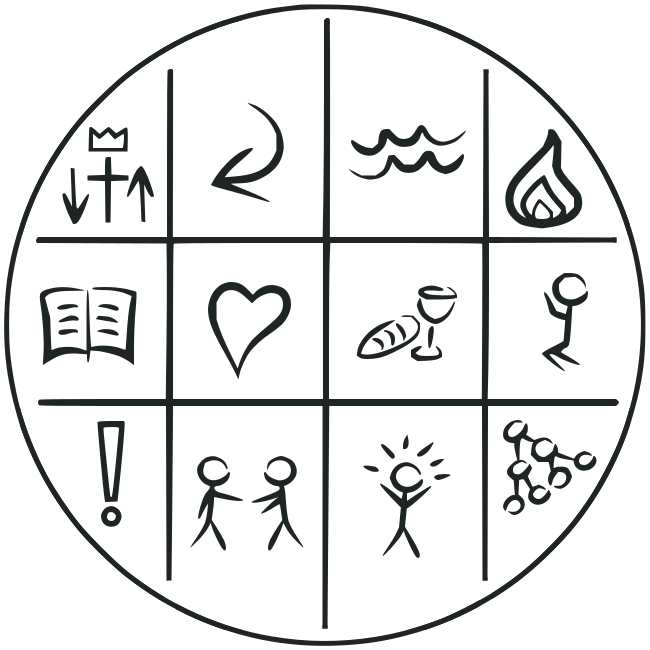
There are twelve of them, each with a Scripture and a simple picture, and together they cover what it looks like to follow Jesus and be his church. For the meaning of each one, what are the commands of Christ walks through the list. Here they are, alongside the Church Waffle, which shows the same practices as a healthy church family does them together:
- Repent & BelieveMark 1:15
- Be BaptizedMatthew 28:19
- Holy SpiritActs 4:27-31
- The Word of GodJohn 8:31-32
- Love One AnotherJohn 15:12
- Lord’s SupperLuke 22:19-20
- PrayMatthew 6:9
- Signs & WondersJohn 14:6-14
- GenerosityMatthew 6:1-4
- WorshipMark 12:28-34
- Go…Make DisciplesMatthew 28:18-20
- GatherHebrews 10:24-25













The Best Place to Learn Them Is a Church That Reproduces
Here is the part people miss. You do not learn to obey these commands best in a classroom, or alone with a workbook. You learn them best in a church that is already living them, while you help start a new one. That is the Two-Church Vision, and it is how the commands actually get into a person.
The Two-Church Vision
A church that is training you. A spiritual family already practicing the commands, where you are being discipled, corrected, and formed.
A church you are helping to start. A new, simple church out among people who do not yet know Jesus, where you immediately practice with others what you are learning.
You need both. In the first, you see the commands lived by people further along, with reproducing DNA you can catch. In the second, you practice them yourself with new people, which is the only way they truly become yours. This is the “be with him, and be sent out” rhythm of Mark 3:14, and it is the whole argument of how to multiply disciples and churches. Learning the commands where they are being reproduced, and immediately reproducing them, is what keeps them from staying theory.
You do not learn to obey Jesus in a classroom. You learn it in a church that is living the commands, while you help start one that is learning them.

TAKE THE NEXT STEP
A list of commands you only read about disciples no one, and starts no church.
Explore the twelve commands of Christ, each with a simple way to practice it, and start walking a group through them.
Practice Your Way Into Being Church
Now put it together. When you gather a new group, you take them through all twelve commands, one at a time. For each command, you do two things: you understand it simply from Scripture, and you make a commitment together to actually practice it. Not “we agree this is true,” but “here is how we will obey this, starting now.”
As the group works through the twelve, something happens without anyone forcing it. They are baptizing, praying, taking the Lord’s Supper, loving one another, giving, worshiping, gathering, making disciples. They are doing the very things a church does. They are not attending a church or planning to launch one someday. They are practicing their way into being one.
That is why the commands and the Church Waffle belong together. The waffle is a picture of the practices of a healthy church, and the commands are how a group learns to obey them. Work through all twelve with real commitments, and you have a group already functioning as a church.
Then comes the important moment: the group names it. At some point they look at what they have become and recognize it. They self-identify as a church, taking ownership of that reality rather than waiting for permission. Knowing when a group has crossed that line is worth thinking about ahead of time, which when a discipleship group becomes a church walks through.
Then Start Another
Because you learned the commands inside a reproducing church, you already know what to do next. As disciples in this new church take ownership and the right DNA shows up in them, you help them do the very thing that was done with them: gather their own people and begin walking a new group through the same twelve commands. That is how a simple church starts another church, and it is why the commands are a training tool and not just a teaching one. Each group that practices its way into being church can turn around and lead the next.
Obedience, not a checklist
The twelve commands are not a doctrine test to pass or a legalistic list to grind through. Jesus tied obeying his commands to loving him: “if you love me, keep my commands” (John 14:15). The point is not to complete the set, it is to love and follow Jesus together, letting obedience become the DNA of a real family. Add commands at the speed the group is actually obeying them, not faster, and never let practicing them harden into performing them.
Start This Week
- Gather a few people and pick the first command. Open the commands of Christ and start with Repent and Believe.
- Understand it, then commit together. Read the Scripture, then decide out loud how you will actually obey this one, starting now.
- Practice, then add the next. Live it out this week, and only move to the next command as the last one is being obeyed. Keep going until the group is doing what a church does.
Frequently asked questions
What are the twelve commands of Christ?
They are a simple, reproducible set of things Jesus told his followers to obey: repent and believe, be baptized, receive the Holy Spirit, live in the Word, love one another, take the Lord’s Supper, pray, expect signs and wonders, give generously, worship, go and make disciples, and gather. Each has a Scripture and an icon. See what are the commands of Christ for the meaning of each, and obey.tools for the full tool.
Where do you learn the commands of Christ?
Best of all inside a church that is already living them, while you help start a new one. This is the Two-Church Vision: you are formed in a church with reproducing DNA and you immediately practice the commands with new people in a church you are helping to start. Learning them where they are being reproduced, and reproducing them yourself, is what makes them stick.
How do you train disciples with the commands of Christ?
Take a group through all twelve, one at a time. For each command, understand it simply from Scripture and make a real commitment together to obey it now. As the group practices the twelve, they begin doing the things a church does, and they practice their way into being a church, which they then recognize and name for themselves. Then they help start another group and do it again.
Is this the same as a discipleship class?
No. A class aims at understanding; this aims at obedience and at becoming a church. The commands are practiced together with commitments, in the context of a reproducing church, not studied alone. If a group finishes “the material” but is not obeying and is not becoming a church, the training has not done its job, however much they learned.