
What Is an Oikos?
An oikos is your household: your natural web of everyday relationships, including family, friends, coworkers, and neighbors, the people you already see. The word is Greek for household, and in the New Testament the gospel usually traveled along these lines of trust. Your oikos is the mission field God has already placed around you, and you can map it on one sheet of paper.
That is the short answer. The longer one is worth having, because “oikos” is one of those words that sounds like insider jargon and is actually describing something you already have. You do not have to build an oikos or go find one. You woke up inside yours this morning.
What the Word Means
Oikos is a Greek word from the New Testament. It simply means a household, or a house. In the ancient world a household was bigger than the people who shared your last name. It included extended family, servants, workers, and the regular relationships that ran through a home. So oikos points at your natural web of relationships, the people already connected to your life.
Everybody has one. Yours is made of the people you live with, the family you call, the friends you text, the coworkers you see every week, your neighbors, and the people around the ordinary rhythms of your life, from the gym to the school pickup line.
Oikos in one line
Your oikos is the household and web of everyday relationships God has already placed around you: family, friends, coworkers, and neighbors. It is your personal mission field, and you did not have to go looking for it.
Your Oikos Is Your Mission Field
Here is why the word matters. When we think about reaching people who do not yet know Jesus, we usually picture strangers, and the whole thing feels intimidating. But in the Bible, faith normally spread along oikos lines, from one person to the people already close to them.
When Jesus healed the man tormented in the region of the Gerasenes, the man wanted to follow him. Jesus sent him home instead:
Mark 5:19Jesus did not let him, but said, “Go home to your own people and tell them how much the Lord has done for you, and how he has had mercy on you.”
“Your own people” is his oikos. That is where Jesus sent him first. You see the same thing across the New Testament: whole households coming to faith together. The Philippian jailer was told, “Believe in the Lord Jesus, and you will be saved, you and your household” (Acts 16:31), and that night his whole house was baptized. Lydia and her household, Cornelius and his, the same pattern again and again.
The gospel travels fastest along existing lines of trust. A stranger has no reason to believe you. The people in your oikos have watched your life, and when God changes you, they are the first to notice. That is not a loophole. It is how God has usually worked.
You do not have to go find a mission field. You woke up inside one this morning.
How to See Your Oikos
Most people underestimate their oikos badly. Ask someone how many people they know who do not follow Jesus and they will say “not many,” until they actually write the names down.
A simple way to see yours is to look at your life through four lenses and let the names come:
- Passion. The people you share interests with: the team, the hobby, the gym, whatever you already enjoy doing alongside others.
- People. The ones already closest to you: family and close friends, the relationships you have whatever you do or wherever you live.
- Place. The people connected to where you live and move: neighbors, your street or building, the regular stops in your day.
- Profession. The people you work or study with, the ones you see most weeks.
Write real names under each. Do that honestly and the page fills up faster than you expect. Passion, people, place, and profession are the same lenses the 4-1-1 tool below uses to map an oikos, so this is not busywork, it is the first move of a proven next step. For the fuller on-site version, mapping your oikos and building a daily habit of praying for it is the second of the 3 core habits of a disciple.
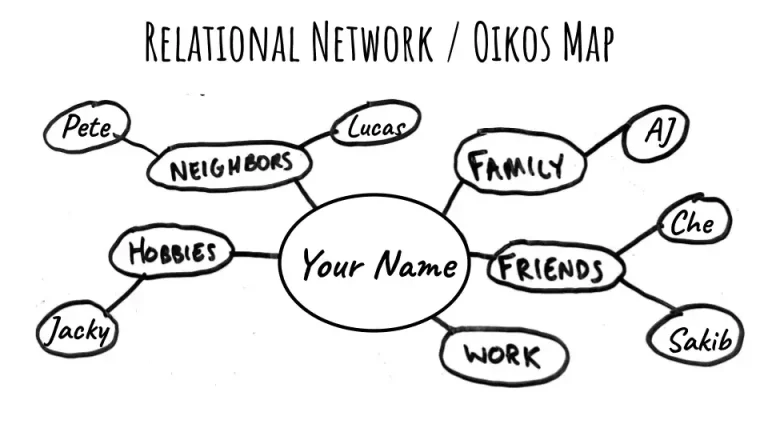
Turn Your Map Into a First Step
A map you never act on is just a nice drawing. The clearest next step is a tool called 4-1-1, which starts from the Great Commission (“go and make disciples,” Matthew 28:18-20) and answers the four questions you need in order to actually begin:
- Why? Your identity. Jesus said, “Follow me, and I will send you out to fish for people” (Mark 1:17). You follow him, and you fish.
- Who? Your oikos, mapped by passion, people, place, and profession, the list you just started.
- How? Your 15-second story and the 3 Circles gospel tool: simple ways to say what Jesus has done and explain the good news.
- When? Goals. Decide who you will pray for, who you will share with, and who you will meet with, and put real dates on it.
Your oikos map is the “Who.” The 4-1-1 tool sets it inside the rest, so seeing your people turns into actually praying for them, sharing with them, and meeting.
TAKE THE NEXT STEP
A map you never act on is just a nice drawing.
The 4-1-1 tool takes your oikos map and turns it into a first step: why you go, who is on your list, how to tell your story, and when you will pray, share, and meet.
An oikos is not a project
The moment your list of names turns into a list of targets, you have lost the plot. These are people you love, not conversions to collect. Map your oikos so you pray for real people and notice where God is already working, not so you can run a campaign on your friends. Love them whether or not they ever believe. That love is exactly what makes the relationship real enough for the gospel to travel across it.
Oikos and the Person of Peace
Once you can see your oikos, you start watching for something specific: the people in it, or connected to it, who are unusually open. The Bible calls that kind of person a person of peace, someone who welcomes you, listens, and often opens up their own network to you.
Your oikos is where you look first, and a person of peace is often the door into a whole new oikos beyond your own. That is how one changed life reaches a network, and then a network reaches a network.
Seeing your mission field is the start. The next question is what you actually say when the door opens, and that is what how to share the gospel is for. Your oikos gives you the people; the gospel gives you the message worth bringing them.
Do This This Week
- Write your oikos down. Take one sheet of paper and list the names that come up under passion, people, place, and profession. Do not edit. Just write.
- Circle a few. Note the two or three who seem most open, or most on your heart.
- Pray for them by name, daily. Pray for them by name: ask God to work in their lives and to give you natural chances to love them and point them to Jesus. Then watch for the doors he opens.
Frequently asked questions
What does oikos mean?
Oikos is a Greek word meaning household or house. In the New Testament it refers to more than a nuclear family: it is the whole web of relationships connected to a person, including extended family, friends, coworkers, and neighbors. Today it is used to describe your natural network of relationships, your personal mission field.
What is an oikos in the Bible?
In the Bible, an oikos is a household, and it is often where faith spread. Jesus sent the healed man in Mark 5:19 back to “his own people,” and the New Testament repeatedly shows whole households believing together, such as the Philippian jailer’s household (Acts 16:31-34), Lydia’s household (Acts 16:15), and Cornelius’s household (Acts 10-11). The gospel traveled along these existing relationships.
How do I find my oikos?
You already have one. To see it, write down the people already in your life under a few categories: family, friends, work or school, neighbors, and the places you keep seeing the same faces. Most people are surprised how many names appear. Then pray for those names and pay attention to who is open.
Is oikos evangelism biblical?
Yes, in the sense that reaching the people already around you is exactly how the gospel usually spread in the New Testament. “Oikos” is a biblical word, though “oikos evangelism” is a modern label for the practice. The caution is to love the people in your oikos genuinely rather than treating them as a project. The relationships are real first, and the gospel travels across real relationships.