
How to Write Your Testimony
Getting your story onto paper is the part most people skip. Here is a simple way to write it in three parts, one line at a time.
To write your testimony, tell your story in three parts: what your life was like before you followed Jesus, how you met Him, and what has changed since. Write two or three honest sentences for each part, and keep it short enough to say in a normal conversation. If you plan to share it in a conversation, prepare a simple question that gives the other person room to respond.
That is the whole framework. The rest of this page is just how to fill it in, one line at a time, and what to cut.
You don’t need a dramatic rescue story or a theology degree to write a good one. The simplest testimony in the Bible is a single sentence from a man Jesus healed:
John 9:25“One thing I do know. I was blind but now I see!”
A before, an after, and the truth of what happened in between. That’s the shape you’re writing toward. If you can say what your life was like, what Jesus did, and what is different now, you already have the raw material.
First, know what you’re writing
Your testimony is your story, what happened to you. It is not the same thing as the gospel, which is the news about Jesus, that He lived, died for sin, rose again, and calls people to follow Him.
Both matter, and they do different jobs. Nobody is saved by hearing your before-and-after; they’re saved by trusting Christ. But your story opens the door. It makes a spiritual conversation feel possible instead of confrontational, so you can walk someone through the gospel itself afterward. If you want the fuller picture of how a testimony works and how to say it out loud, start with how to share your testimony. This page is about the part most people skip: actually writing it down.
Writing it matters because a story you’ve shaped once, in private, comes out clearer when you’re nervous. You won’t be hunting for words in the moment.
The three parts to write around
Almost every usable testimony follows the same arc, whether it ends up fifteen seconds long or three minutes long. Write around these three parts and you can’t get lost.
The Shape to Write
Before. What your life and heart were like before you followed Jesus.
How you met Jesus. The point things turned, what you came to understand about Him, and what you did about it.
After. What is honestly different now, because of Him.
This isn’t a modern formula. It’s how the Bible tells these stories. When Paul stood on trial before King Agrippa, he told his own testimony in exactly this order (Acts 26): before, he violently opposed Jesus and dragged Christians to prison; then he met the risen Christ on the road to Damascus; after, he could not stop telling people to turn to God. Same three movements you’re about to write.
Write it in five steps
Give this twenty minutes with a pen or a notes app. Write badly on the first pass. You’ll fix it in step five.
Draft It in Five Steps
- Write your “before.” Two or three honest sentences about your life or heart before Christ. Name the real thing, whether that was fear, emptiness, running your own life, or guilt, rather than a cartoon version of it.
- Write the turn. Describe the point things changed without embellishing it. What did you come to understand about Jesus, and what did you do, whether that was believing, repenting, or starting to follow Him as King? For many people, this happened gradually rather than on one specific day, and that is fine to say.
- Write your “after.” Name one or two things that are different now. Keep it true to today, not a highlight reel.
- Prepare a conversational bridge. If you plan to share your testimony in conversation, write down a natural question you could ask afterward, such as, “Has anything like that ever happened to you?” Do not force the question if the conversation is already moving naturally.
- Read it out loud and cut. Remove anything you stumble over, any word an outsider wouldn’t use, and anything that makes the story more about you than about Jesus.
Step five is where a rough draft becomes usable, so don’t skip it. Reading it aloud exposes the sentences that look fine on paper but tie your tongue in knots.
Watch your vocabulary especially. If you’d never say a word at a coffee shop, like “redeemed,” “convicted,” or “backslidden,” find a plainer way to say the same thing. Insider language can make someone feel like the story was not meant for them.
What it looks like put together
Here is an illustrative draft showing how the three parts can fit together. Yours will sound like you, not like this, but the bones are the same:
For years I believed in God but ran my own life, and underneath the busyness I was anxious and tired of trying to be good enough. Then I actually met Jesus, asked Him to forgive me, and started following Him instead of just believing He existed. I still have hard days, but I’m not carrying the weight of proving myself anymore, and I have a peace I didn’t used to have. Has anything like that ever happened to you?
Notice how short the “before” is. It gives just enough to make the change believable and then moves on. The most words land on the turn and the after. This draft ends with a question, which is one possible conversational bridge rather than a required part of the testimony. That’s the balance you’re aiming for.
For more patterns to imitate, the testimonies recorded in Scripture are worth reading with your own draft open beside them.

TAKE THE NEXT STEP
A testimony that stays on the page never opens a single conversation.
The 15-second testimony turns the draft you just wrote into a short version you can practice out loud until it feels natural.
Common mistakes to edit out
Once your draft exists, most of the work is subtraction. These are the traps to watch for on your second read.
Edit These Out
Making it all about the “before.” Lingering on every detail of the drama, the rock bottom, the wild years, until Jesus is barely a footnote at the end. Give enough of the before to make the change believable, and no more.
Ending at “and now my life is great.” That overpromises. Following Jesus brings forgiveness, peace, and purpose, but it does not guarantee health, money, or an easy road. A testimony that oversells falls apart the first time the listener’s life gets hard.
Turning it into a speech. A testimony should leave room for the other person. When you share it in conversation, pause and ask a natural question rather than forcing a scripted ending.
The through-line to protect is simple. When Jesus sent the man He freed from a legion of demons back home, He told him what to talk about:
Mark 5:19“Go home to your own people and tell them how much the Lord has done for you, and how he has had mercy on you.”
How much the Lord has done for you. That’s the center of gravity. If an edit pulls attention off Him and onto you, cut it.
Write two lengths while you’re at it
You’ll actually use two versions of the same story, so write both now.
The short version, about fifteen seconds, is the one you’ll reach for most: a quick before, the turn, the after, and a question. It fits into a passing conversation without taking it over. Learn to write this one first. The 15-second testimony examples give you templates to adapt and show the format worked out line by line.
The full version, two or three minutes, is the same three parts with more room to breathe, for when someone leans in and wants to hear more. Get the short one right and the long one is mostly an expansion of it. When you need that longer version, whether for a baptism or a small group, the three-minute testimony shows you where the extra time goes.
Once it’s written, say it
Writing your testimony is worth doing, but the page was never the point. A story that lives only in a notebook has never started a single conversation.
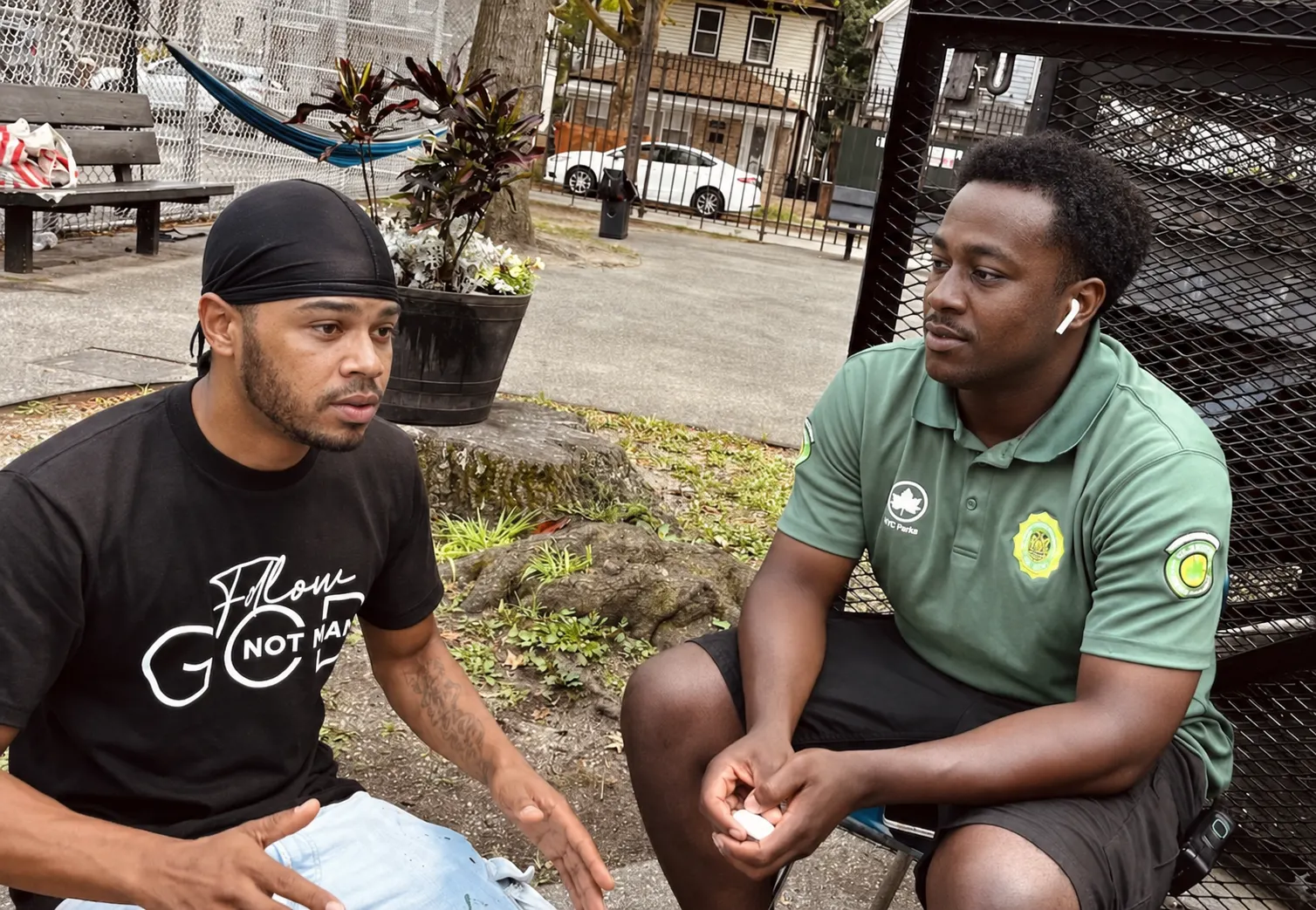
Anthony shares his testimony with a New York City Parks employee during a conversation in the neighborhood.
So take the next step from here. Practice the short version until it feels natural, then look at how to evangelize in five simple steps, which picks up where your story leaves off, so a good conversation doesn’t stall at “that’s nice for you.” Your testimony gets the door open; knowing how to share the gospel is how you walk through it.
Frequently Asked Questions
How long should a written testimony be?
Write it in two lengths. A fifteen-second version for passing conversations, and a two-to-three-minute version for when someone wants to hear more. Lead with the short one. If your written draft runs longer than three minutes, you’re probably narrating the “before” in too much detail.
What if I don’t have a dramatic conversion story?
A quiet story is still worth writing. “I always believed in God but was living for myself and felt empty, and then I started actually following Jesus as King, and that changed things” connects with a lot of people, because that is their situation too. You don’t need a rock-bottom to have a genuine before-and-after.
Do I need to remember the exact date I was saved?
No. Many people can’t name a single day, because their turn to Jesus came gradually. Write “over time I came to see” or “there was a season when” instead of forcing a date. What matters is that you’re following Him now and can name what’s different.
Should I write it word for word or just an outline?
Write it out in full first, because that’s how you find the clunky sentences and cut them. Then learn the shape, not the script. In a real conversation you want to speak your testimony, not recite it, so once you’ve drafted and trimmed it, practice from the three parts rather than reading it off a page.
What if my past is too messy to write about?
Name what happened without giving unnecessary details. “I was caught in addiction” or “I’d hurt people I loved” is enough. Your honesty makes the change believable, and the details usually pull attention away from Jesus rather than toward Him.
Put your pen down and open your mouth
You can write your testimony this week. Three honest parts, read aloud and trimmed, with a simple question ready if you plan to share it in conversation. It’s one of the few things you can say with full confidence, because it happened to you, and nobody can argue you out of your own experience.
The goal was never a well-written page. It was a story you can say out loud to the next person who asks why you have hope.
Write it this week, then say it to one person.